


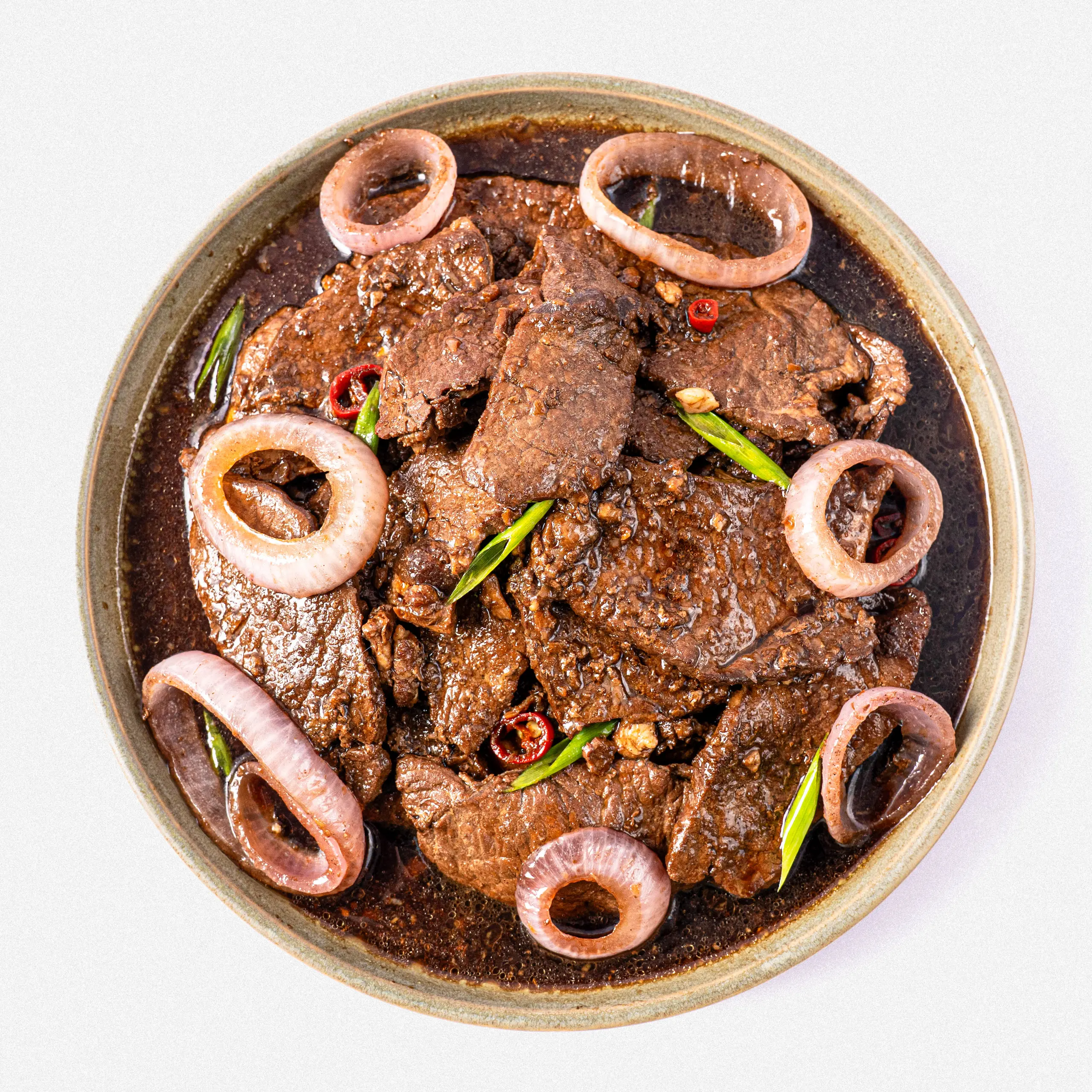
There are Filipino dishes that are instantly recognizable from their aroma alone, and Bistek Tagalog is definitely one of them. The moment beef hits a hot pan with garlic, soy sauce, and calamansi, the kitchen starts smelling like a proper Filipino home-cooked meal.
Bistek is simple food, but it has a wonderful balance. The beef is savory and rich, the soy sauce provides saltiness and umami, while calamansi cuts through everything with its bright, citrusy sourness. Then come the onions—soft, sweet, and slightly caramelized—which bring the whole dish together.
It is also one of those recipes that doesn’t need much to become a complete meal. Put the saucy beef and onions over a mound of steaming white rice, and you already have something deeply satisfying. It is the kind of dish that works just as well for an ordinary family dinner as it does for a weekend meal when you want something a little more special.
This version uses thinly sliced beef marinated and cooked with soy sauce and calamansi, then finished with garlic, butter, chili, black pepper, and plenty of red onion rings. The result is savory, tangy, slightly spicy, and wonderfully comforting.
What Is Bistek Tagalog?
Bistek Tagalog is a Filipino beef dish traditionally made with thinly sliced beef, soy sauce, calamansi juice, and onions.
The name bistek is generally understood to be derived from the Spanish term bistec, meaning steak. The dish, however, has become distinctly Filipino through the use of local ingredients and flavors—most notably calamansi and soy sauce.
Unlike a Western steak that is usually served as a single piece of grilled or pan-seared meat, Bistek Tagalog is typically made with thin slices of beef that are cooked in a savory citrus-soy sauce.
The onions are just as important as the beef. They are often cooked until tender and slightly sweet, then arranged over the meat or mixed into the sauce.
The finished dish is not meant to be overly complicated. Its appeal comes from the balance of just a few powerful flavors.
A Little History of Bistek Tagalog
Bistek Tagalog is a good example of how Filipino cuisine has absorbed outside influences and transformed them into something uniquely local.
The name is connected to Spanish culinary influence, particularly the word bistec. The Philippines was under Spanish colonial rule for centuries, and Spanish vocabulary and cooking concepts became part of Filipino food culture.
But the dish you find on a Filipino dining table is not simply a Spanish steak.
The use of soy sauce gives it a distinctly Filipino and broader Southeast/East Asian character, while calamansi provides the sharp citrus flavor that is central to the dish.
The abundance of onions is another characteristic feature. Filipino cooks often use onions generously in Bistek because their sweetness balances the salty and sour sauce.
Like many home-cooked Filipino dishes, Bistek Tagalog also has countless variations. Some cooks use more calamansi, some add more soy sauce, some include garlic, while others keep the ingredient list very simple. Some prefer the beef tender and saucy, while others cook the meat until the sauce becomes concentrated and the edges begin to caramelize.
There isn’t necessarily one perfect version.
The best Bistek is often the one that tastes like home to you.
Choosing the Right Beef
Because Bistek uses thin slices, the cut of beef matters.
Good options include:
- Beef sirloin
- Top round
- Bottom round
- Beef tenderloin
- Ribeye, for a richer version
- Beef chuck, if sliced very thinly and cooked appropriately
For an everyday version, sirloin or another reasonably lean cut works well.
If you’re using a tougher cut, slicing it correctly becomes especially important.
Always slice the beef against the grain.
Look at the direction of the muscle fibers and cut perpendicular to them. This shortens the fibers and makes the meat easier to chew.
If the beef is difficult to slice thinly, place it in the freezer for around 20–30 minutes. It will firm up slightly and become much easier to cut into thin, even slices.
Why Searing the Beef First Helps
It may be tempting to simply put the raw beef directly into the sauce, but briefly searing it first can add another layer of flavor.
The high heat creates browning on the surface of the meat.
That browned flavor then combines with the soy-calamansi sauce later.
Just don’t cook the thin beef for too long during this stage.
Overcooking thin slices can make them tough.
Recipe Tips for Better Bistek Tagalog
Slice against the grain
This is probably the single most important tip for tender Bistek.
Even a good cut of beef can seem tough if it is sliced in the direction of the muscle fibers.
Don’t overcrowd the pan
When too much beef is placed in the pan at once, it releases moisture and begins steaming instead of browning.
Cook in batches if necessary.
Don’t overcook thin beef
Thin slices don’t need much cooking time.
If you simmer them aggressively for too long, they can become chewy.
Balance the soy sauce and calamansi
Soy sauce is salty, while calamansi is acidic.
Neither should completely dominate the dish.
Taste and adjust.
Give the onions some attention
Don’t treat onions as a garnish that can be added at the last second without thought.
They provide sweetness that balances the sauce.
Cook them until they reach your preferred texture.
Don’t throw away the marinade
It contains much of the flavor from the soy sauce, calamansi, garlic, and pepper.
Just remember that because it contacted raw meat, it needs to be thoroughly cooked before serving.
Ingredient Substitutions
Beef
You can substitute:
- Chicken
- Pork
- Beef strips
- Thinly sliced mushrooms for a meatless version
The cooking time will change depending on the protein.
Calamansi
If fresh calamansi isn’t available, you can use:
- Lemon juice
- Lime juice
- A combination of lemon and lime
Calamansi has a distinctive aroma and flavor, so substitutions won’t taste exactly the same.
For the closest experience, use fresh calamansi whenever possible.
Soy Sauce
Regular Filipino-style soy sauce works well.
If you prefer a less salty version, use a reduced-sodium soy sauce.
You can also replace part of the soy sauce with coconut aminos, although the flavor will be different.
Red Onion
You can substitute:
- White onion
- Yellow onion
- Sweet onion
Red onion is especially attractive in the finished dish, but the important thing is having plenty of onion.
Butter
Butter can be omitted.
You can simply use cooking oil.
Alternatively, a small amount of margarine or another cooking fat can provide similar richness.
Red’s Eye Chili
You can use:
- Thai chili
- Finger chili
- Jalapeño
- Long green chili
- Red pepper flakes
Or leave it out completely.
Traditional Bistek doesn’t need to be spicy.
Understanding the Main Ingredients
Beef
Beef gives Bistek its hearty, savory character.
Thinly sliced beef also allows the sauce to coat almost every part of the meat.
Because the meat is sliced thinly, the dish can be prepared relatively quickly compared with stews that use large pieces of beef.
Soy Sauce
Soy sauce provides the dish with:
- Saltiness
- Umami
- Deep color
- Fermented complexity
It is one of the dominant ingredients, so choosing a soy sauce you enjoy can make a noticeable difference.
Calamansi
Calamansi is a small citrus fruit commonly used in Filipino cuisine.
It has a bright, aromatic acidity that is particularly good with rich meats.
In Bistek, it does more than simply make the dish sour.
The acidity helps balance the richness of the beef and saltiness of the soy sauce.
Onion
Onions become surprisingly sweet and tender when cooked.
This sweetness is important because it balances the salty, acidic sauce.
That’s why Bistek is rarely complete without a generous amount of onion.
Garlic
Garlic adds aroma and savory depth.
It also works beautifully with both soy sauce and calamansi.
Butter
Butter contributes richness and a smooth mouthfeel.
It is optional, but it can make the sauce feel more luxurious.
Is Bistek Tagalog Healthy?
Bistek can certainly be part of a balanced meal, particularly when served with plenty of vegetables.
Beef provides high-quality protein and nutrients such as iron, zinc, vitamin B12, and selenium.
Calamansi contributes vitamin C and other plant compounds.
Onions provide fiber and various beneficial plant compounds.
However, Bistek can also be relatively high in sodium, primarily because of the soy sauce. The amount of oil and butter can also increase its calorie and fat content.
So the healthiest approach is not necessarily to eliminate the ingredients that make Bistek delicious, but to pay attention to portions and balance the meal with vegetables.
Health Benefits of the Ingredients
Beef
Beef is a good source of complete protein.
It also provides highly absorbable iron, which is important for normal red blood cell production, along with zinc and vitamin B12.
Calamansi
Calamansi contributes vitamin C.
The acidic juice also allows you to create a bold flavor without needing additional heavy sauces.
Onion
Onions provide dietary fiber and plant compounds such as flavonoids.
Garlic
Garlic contains sulfur-containing compounds and adds substantial flavor with very few calories.
Black pepper
Black pepper contributes flavor and contains plant compounds such as piperine.
Chili
If included, chili peppers provide capsaicin and can contribute vitamin C and other antioxidants.
How to Make a Lighter Bistek
If you’d like a lighter version without losing its personality:
- Choose a lean cut of beef.
- Trim visible fat.
- Reduce the amount of oil.
- Use less butter or omit it.
- Use reduced-sodium soy sauce.
- Increase the amount of onions.
- Add vegetables such as mushrooms, bell peppers, or bok choy.
- Serve with a moderate portion of rice.
You can also use more calamansi and black pepper to maintain a bold flavor while reducing some of the soy sauce.
What to Serve with Bistek Tagalog
Bistek and rice are almost inseparable.
The savory sauce is made for spooning over steaming white rice.
For a more complete Filipino meal, serve it with:
- Steamed vegetables
- Atchara
- Tomato and salted egg salad
- Blanched kangkong
- Ginisang vegetables
- Cucumber salad
- Ensaladang talong
The acidity of a fresh vegetable side or atchara can complement the rich beef beautifully.
Bistek Tagalog Flavor Variations
Sweeter Bistek
Add a small amount of brown sugar to the sauce.
This creates a slightly sweeter, more caramelized flavor.
Extra-Sour Bistek
Increase the calamansi juice.
This is excellent if you love the sharp citrus character.
Garlic Bistek
Increase the garlic and finish the dish with crispy fried garlic.
Spicy Bistek
Add more red’s eye chilies or use a hotter chili variety.
Bistek with Mushrooms
Add sliced mushrooms to the sauce.
They absorb the soy-calamansi flavors beautifully and can stretch the dish when you’re feeding a larger group.
Common Mistakes to Avoid
Using thick beef slices: They take longer to cook and may become tough.
Slicing with the grain: This makes the meat harder to chew.
Using too much soy sauce: It can overwhelm the calamansi.
Adding too much calamansi: Excess acidity can make the sauce unpleasantly sharp.
Overcooking the beef: Thin slices become chewy quickly.
Burning the garlic: This introduces bitterness.
Overcooking the onions: Unless you specifically want very soft onions, keep some texture.
Not tasting the sauce: Soy sauce and calamansi vary in intensity, so always adjust according to taste.
A Simple Way to Understand Bistek’s Flavor
A good Bistek Tagalog is really about balance.
The soy sauce provides salt and umami.
The calamansi provides acidity.
The beef provides richness and protein.
The onions provide sweetness.
The garlic provides aroma.
The black pepper and chili provide warmth and a little heat.
The butter rounds everything out.
When these flavors work together, the dish becomes much more interesting than simply “beef in soy sauce.”
Final Words
Bistek Tagalog is one of those Filipino dishes that proves you don’t need a long ingredient list to create something memorable.
The foundation is remarkably simple: thinly sliced beef, soy sauce, calamansi, garlic, and onions. Yet those ingredients come together in a way that is unmistakably Filipino.
There is something special about the combination of salty soy sauce and sharp calamansi. The citrus keeps the beef from feeling too heavy, while the onions soften and become naturally sweet. Spoon that sauce over hot rice, and suddenly even a simple dinner feels complete.
It is also a dish that welcomes personal preference. If you like your Bistek extra sour, add more calamansi. If you’re a fan of onions, use plenty. If you enjoy spice, add chili. If you prefer a milder flavor, leave the chili out and let the beef, citrus, and onions take center stage.
Most importantly, don’t be afraid to adjust the recipe until it tastes right to you.
Bistek Tagalog is Filipino comfort food at its best—savory, tangy, aromatic, satisfying, and uncomplicated. It is the kind of dish that belongs beside a bowl of steaming rice and a few simple Filipino side dishes, preferably with enough sauce left in the pan for everyone to spoon a little extra onto their rice.
And when the last piece of beef is gone but someone is still using a spoon to collect the remaining sauce and onions, you’ll know you’ve made a good Bistek.