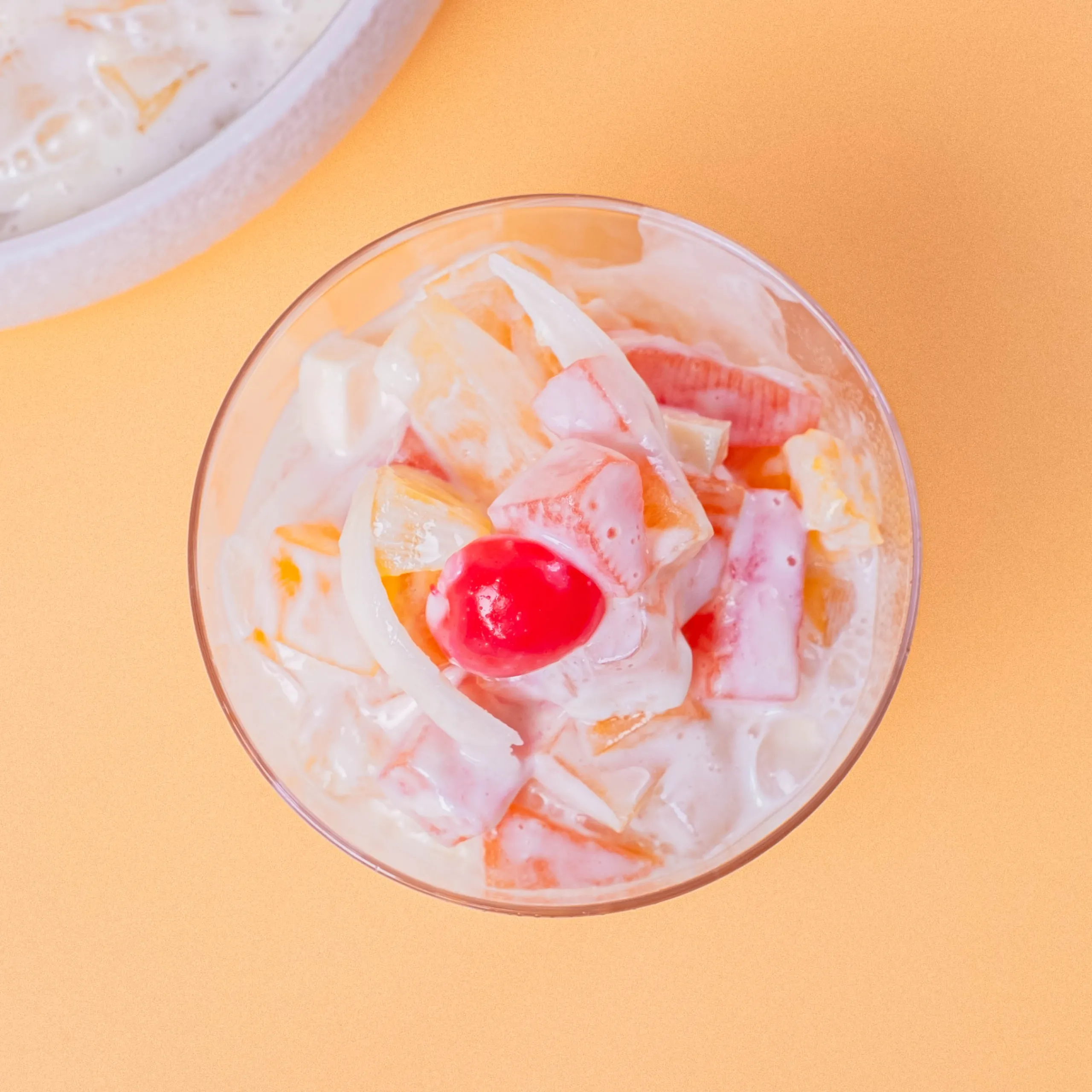


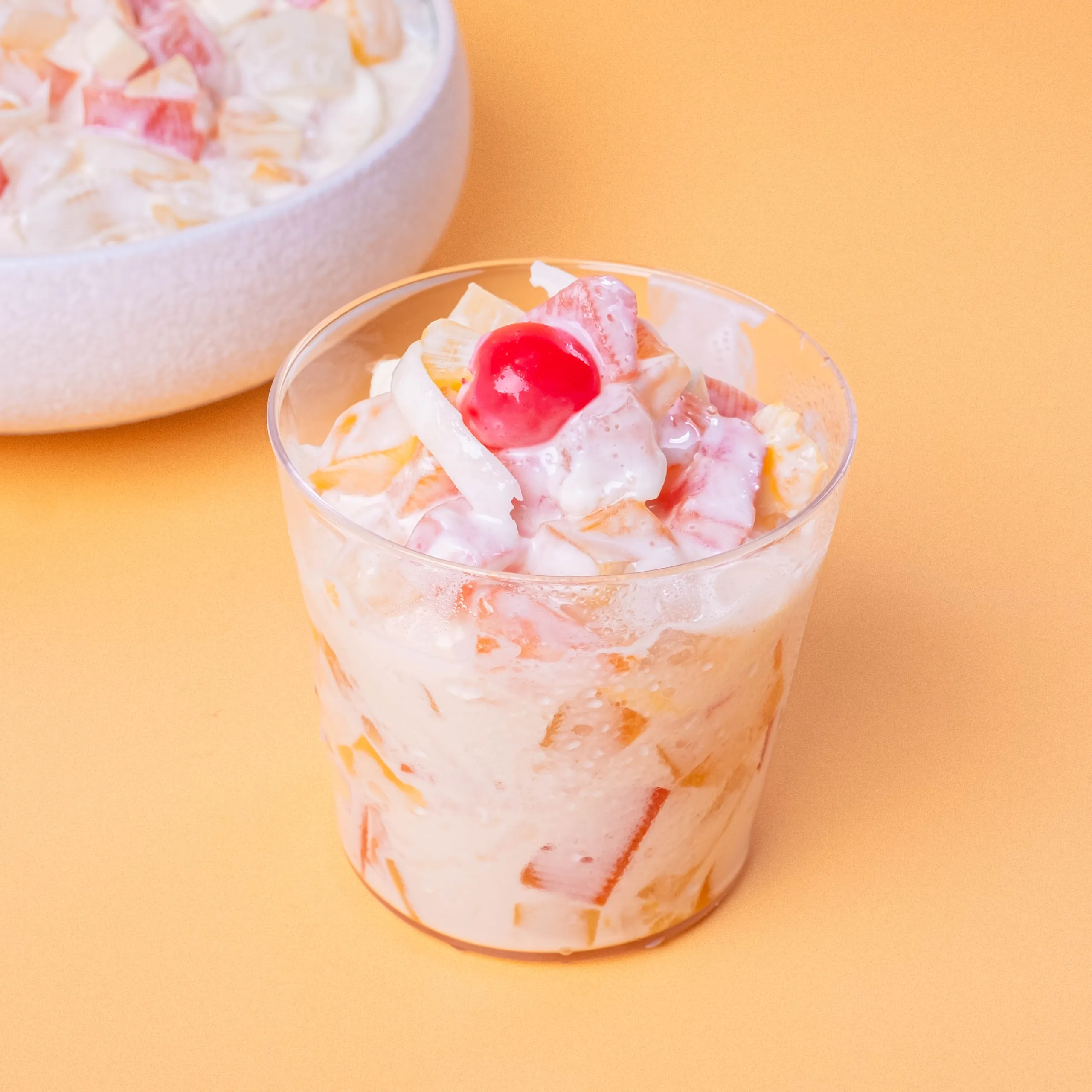
Filipino fruit salad is one of those desserts that can instantly bring back memories of family gatherings, birthdays, Christmas celebrations, fiestas, and long afternoons spent around a table filled with food. It is creamy, sweet, colorful, and incredibly easy to prepare, which is one reason it has become such a familiar dessert in Filipino households.
Unlike a traditional fresh-fruit salad that relies mostly on the natural flavors of fresh produce, Filipino fruit salad is typically made with canned fruit cocktail, sweetened condensed milk, and all-purpose cream. What makes it distinctly Filipino is the way these ingredients are combined into a rich, creamy dessert and often enhanced with ingredients such as young coconut, cheese, nata de coco, kaong, or other preserved fruits.
This version uses cheddar cheese and young coconut meat, creating an interesting combination of sweetness, creaminess, mild saltiness, and chewy texture. The cheddar may seem unusual if you have never tried Filipino-style fruit salad, but it is actually one of the ingredients that makes the dessert so recognizable. Small cubes of cheese provide a salty, savory contrast to the sweet fruit and creamy dressing.
The recipe is also wonderfully practical. There is no stove, oven, or complicated technique required. Most of the work involves draining, mixing, chilling, and waiting patiently for the flavors to come together.
That simplicity makes fruit salad an especially useful dessert when you are preparing food for a celebration and already have several other dishes to cook. You can make it ahead of time, place it in the refrigerator, and bring it out when everyone is ready for dessert.
History and Cultural Background
Filipino fruit salad is part of a broader tradition of Filipino celebration foods that combine convenience, sweetness, and ingredients that were historically made more accessible through canned and preserved products.
Fruit cocktail became particularly useful in Filipino kitchens because it offered a convenient mixture of fruits without requiring cooks to purchase and prepare several different fresh fruits individually. Canned fruit also made it easier to prepare desserts throughout the year, regardless of seasonal availability.
Over time, Filipino cooks adapted canned fruit cocktail into a creamy dessert by combining it with sweetened condensed milk and all-purpose cream. This transformed the fruit into something richer and more indulgent than a simple bowl of fruit.
The addition of ingredients such as cheese and young coconut further reflects Filipino creativity in the kitchen. Filipino cuisine often embraces combinations of sweet, salty, creamy, chewy, and fruity elements in the same dish.
Fruit salad eventually became closely associated with holidays and special occasions. It is particularly common during Christmas and New Year celebrations, when large families and groups of friends gather around tables filled with food.
It is also a popular dessert for birthdays, fiestas, potlucks, reunions, and other gatherings because it can be prepared in a large container and served to many people.
Unlike some traditional Filipino dishes with very old regional histories, Filipino fruit salad is better understood as a modern Filipino adaptation of ingredients and food practices that became popular over time. Its cultural importance comes less from an ancient origin story and more from the way generations of Filipino families have made it part of celebrations and memories.
Different families also have their own preferred versions. Some add nata de coco, kaong, cherries, apples, grapes, peaches, or other fruits. Others add more cheese, while some leave the cheese out entirely.
That flexibility is part of the charm of Filipino fruit salad.
Understanding the Ingredients
Fruit cocktail
Fruit cocktail forms the colorful and fruity foundation of the dessert.
Commercial fruit cocktail commonly contains a mixture of fruits such as peaches, pears, grapes, cherries, and other pieces, depending on the brand.
Because canned fruit is stored in syrup or juice, draining it thoroughly is extremely important.
Condensed milk
Sweetened condensed milk provides most of the sweetness and contributes a thick, creamy texture.
It is much more concentrated and sweeter than ordinary milk, which is why only a portion is needed to sweeten the entire bowl.
All-purpose cream
All-purpose cream gives the dessert richness and a smooth, velvety texture.
It also helps balance the intense sweetness of the condensed milk.
For an especially creamy fruit salad, the cream should be properly chilled before mixing.
Cheddar cheese
Cheddar cheese provides the salty and savory contrast that makes Filipino fruit salad distinctive.
The cheese also adds a soft but slightly firm texture that contrasts nicely with the fruit and cream.
Mild cheddar generally works well because it complements rather than overwhelms the dessert.
Young coconut meat
Young coconut, sometimes called buko, adds a fresh tropical character.
Its slightly chewy texture provides another layer of contrast to the soft fruit and creamy dressing.
The coconut also helps make the dessert feel more distinctly Filipino.
Recipe Tips
• Drain the fruit extremely well. This is probably the most important tip for preventing watery fruit salad.
• Drain the coconut too. Young coconut can contain a surprising amount of liquid.
• Use chilled cream. Cold ingredients help produce a thicker, more refreshing dessert.
• Add condensed milk gradually. This allows you to control the sweetness.
• Use mild cheddar. A strong, aged cheese can overpower the delicate fruit flavors.
• Cut cheese into small cubes. This creates a better balance between sweet and savory flavors.
• Fold instead of stirring aggressively. This prevents the fruit from becoming crushed.
• Chill before serving. The flavor and texture improve after several hours in the refrigerator.
• Do not add the fruit syrup. Even a little extra syrup can make the dessert excessively watery.
• Do not overfill the mixing bowl. A large bowl makes gentle folding much easier.
• Make it ahead. Fruit salad is an excellent make-ahead dessert for parties.
• Keep it refrigerated. Because the dessert contains dairy and fruit, it should not be left at room temperature for long periods.
• Serve in small portions. The dessert is rich and sweet, so a little can go a long way.
• Add toppings just before serving. This keeps them fresh and attractive.
Ingredient Substitutions
Fruit cocktail
You can replace canned fruit cocktail with a mixture of drained canned peaches, pears, grapes, cherries, and other fruits.
Fresh fruit can also be used, although the final texture and flavor will be different.
If using fresh fruit, choose fruits that are relatively firm and not excessively watery.
All-purpose cream
Heavy cream or whipping cream can be used as an alternative.
If using whipping cream, you can whip it lightly before folding it into the fruit mixture for a somewhat airier dessert.
Condensed milk
Sweetened condensed milk is a defining ingredient, but you can reduce the amount if you prefer a less sweet dessert.
Evaporated milk is not a direct substitute because it is much less sweet and has a thinner consistency.
Cheddar cheese
Mild Edam, Monterey Jack, or another mild semi-firm cheese can be used.
However, cheddar is the classic choice for the familiar Filipino sweet-and-salty contrast.
Young coconut
If fresh young coconut is unavailable, canned or packaged young coconut meat can be used.
Nata de coco can also provide a similar chewy texture, although it has a different flavor.
Raisins
Although not included in this version, raisins can be added if you enjoy extra sweetness and chewy texture.
Nata de coco
Nata de coco is a popular addition and can make the dessert more interesting texturally.
Make sure to drain it thoroughly before adding.
Kaong
Kaong, or sugar palm fruit, is another common addition to Filipino-style fruit desserts.
Drain it well because it is often packed in syrup.
Popular Variations
Fruit Salad with Nata de Coco
Add well-drained nata de coco for a chewy texture.
You can use one color or several colors for a more festive appearance.
Buko Fruit Salad
Increase the amount of young coconut and use a mixture of fruit cocktail and other tropical fruits.
This creates a dessert with a stronger coconut flavor.
Creamier Fruit Salad
Use slightly more all-purpose cream and adjust the condensed milk to taste.
This creates a softer, richer dressing.
Less Sweet Fruit Salad
Reduce the condensed milk and choose fruit packed in juice rather than heavy syrup.
You can also increase the amount of fresh or unsweetened coconut.
Fresh Fruit Version
Use fresh apples, grapes, strawberries, mangoes, peaches, and other firm fruits.
Keep in mind that fresh fruits contain varying amounts of water, so the final dessert may be less thick than a canned-fruit version.
Knowledge About Filipino Fruit Salad
Filipino fruit salad is an excellent example of how food can become culturally meaningful even when its ingredients are not all traditionally native to the Philippines.
Canned fruit cocktail, condensed milk, and cream became increasingly useful in Filipino kitchens as commercially processed foods became more widely available.
Filipino cooks then made these ingredients their own by combining them with familiar flavors and textures such as young coconut and cheese.
The cheese is perhaps the most surprising ingredient for people unfamiliar with Filipino desserts.
In many Western-style fruit salads, cheese would not necessarily be expected. In Filipino fruit salad, however, small pieces of mild cheddar create a salty contrast against the sweet fruit and creamy dressing.
This sweet-and-salty combination is common in Filipino food culture.
The dessert also demonstrates the importance of texture. A good fruit salad contains several different sensations:
- • Soft fruit
- • Creamy dressing
- • Slightly chewy coconut
- • Firm pieces of cheese
The combination makes the dessert much more interesting than a simple bowl of fruit covered in cream.
Another important characteristic is convenience. Filipino fruit salad is often prepared in large quantities because it is intended for sharing.
A large bowl can serve many people, making it particularly suitable for holidays and gatherings.
It is also a dessert that does not require baking. During celebrations when the kitchen is already busy preparing savory dishes, a no-cook dessert can be extremely practical.
Health Benefits and Nutritional Information
Filipino fruit salad can provide some nutritional benefits from its fruit and coconut, but it is also a rich dessert because of the condensed milk and cream.
The nutritional value will vary considerably depending on the specific brands and proportions used.
Fruit
Fruit cocktail can provide carbohydrates, vitamin C, and various micronutrients.
The nutritional value depends on the types of fruit included and whether the fruit is packed in syrup or juice.
Choosing fruit packed in juice rather than heavy syrup can reduce added sugar.
Young coconut
Young coconut provides some fiber, minerals, and plant nutrients.
It also contributes texture without requiring large amounts of additional fat.
However, coconut is not calorie-free and contains some naturally occurring fat.
Cheddar cheese
Cheddar provides protein, calcium, phosphorus, and other nutrients.
Calcium is important for normal bone and tooth health.
Cheese also contributes fat and sodium, so the amount used affects the overall nutritional profile.
All-purpose cream
Cream provides fat and contributes to the rich texture of the dessert.
Because it is relatively energy-dense, portion size is important if you are trying to manage calorie intake.
Condensed milk
Sweetened condensed milk provides sweetness and energy primarily from sugar and milk solids.
It is one of the main reasons Filipino fruit salad is considered an indulgent dessert rather than an everyday low-sugar snack.
Making the dessert lighter
You can make several simple adjustments if you want a lighter version:
- • Reduce the amount of condensed milk.
- • Use fruit packed in juice rather than syrup.
- • Increase the amount of fresh fruit.
- • Use more young coconut and less cheese.
- • Use a lighter cream product where appropriate.
- • Serve smaller portions.
The goal does not have to be eliminating everything that makes the dessert enjoyable. Small adjustments can create a more balanced version while preserving its familiar character.
Serving Suggestions
Filipino fruit salad is best served thoroughly chilled.
It works particularly well after rich Filipino dishes because the cold, sweet, creamy texture provides a refreshing contrast to savory food.
For celebrations, you can serve it in a large glass bowl so that the colorful fruit and cheese are visible.
For individual servings, spoon the salad into small dessert cups or glasses.
You can also garnish each serving with:
- • A small piece of cherry
- • A few cubes of cheddar
- • Shredded young coconut
- • A little additional fruit
- • A small amount of nata de coco
Keep garnishes simple. The colorful fruit salad already makes an attractive dessert on its own.
Final Words
Filipino fruit salad is more than a simple mixture of canned fruit and cream. For many people, it is connected to celebrations, family gatherings, childhood memories, and the excitement of seeing familiar dishes appear on a holiday table.
Its appeal comes from its contrasts. The fruit is sweet and juicy, the cream is rich and smooth, the young coconut is pleasantly chewy, and the cheddar cheese introduces just enough saltiness to keep the dessert from tasting one-dimensional.
The recipe is also incredibly forgiving. You can add nata de coco, kaong, fresh mangoes, apples, grapes, cherries, or other ingredients your family enjoys. You can make it sweeter or less sweet, creamier or fruitier, depending on your preference.
Most importantly, the dessert demonstrates a very Filipino approach to food: taking readily available ingredients and turning them into something festive and memorable. A can of fruit cocktail may be an ordinary pantry item, but when combined with cream, condensed milk, coconut, and cheese, it becomes something associated with birthdays, Christmas dinners, reunions, and family celebrations.
The best fruit salad is not necessarily the one with the most ingredients. It is the one with the right balance of sweetness, creaminess, fruit, and texture. Thoroughly draining the ingredients, using a good-quality cream and mild cheddar, folding everything gently, and giving the dessert enough time to chill can make a tremendous difference.
In the end, Filipino fruit salad is a dessert that feels both simple and celebratory. It requires very little cooking, but it carries a great deal of cultural familiarity. Served cold after a generous Filipino meal, it offers a sweet and refreshing ending—and perhaps most importantly, it is the kind of dessert that invites everyone to take just one more spoonful.