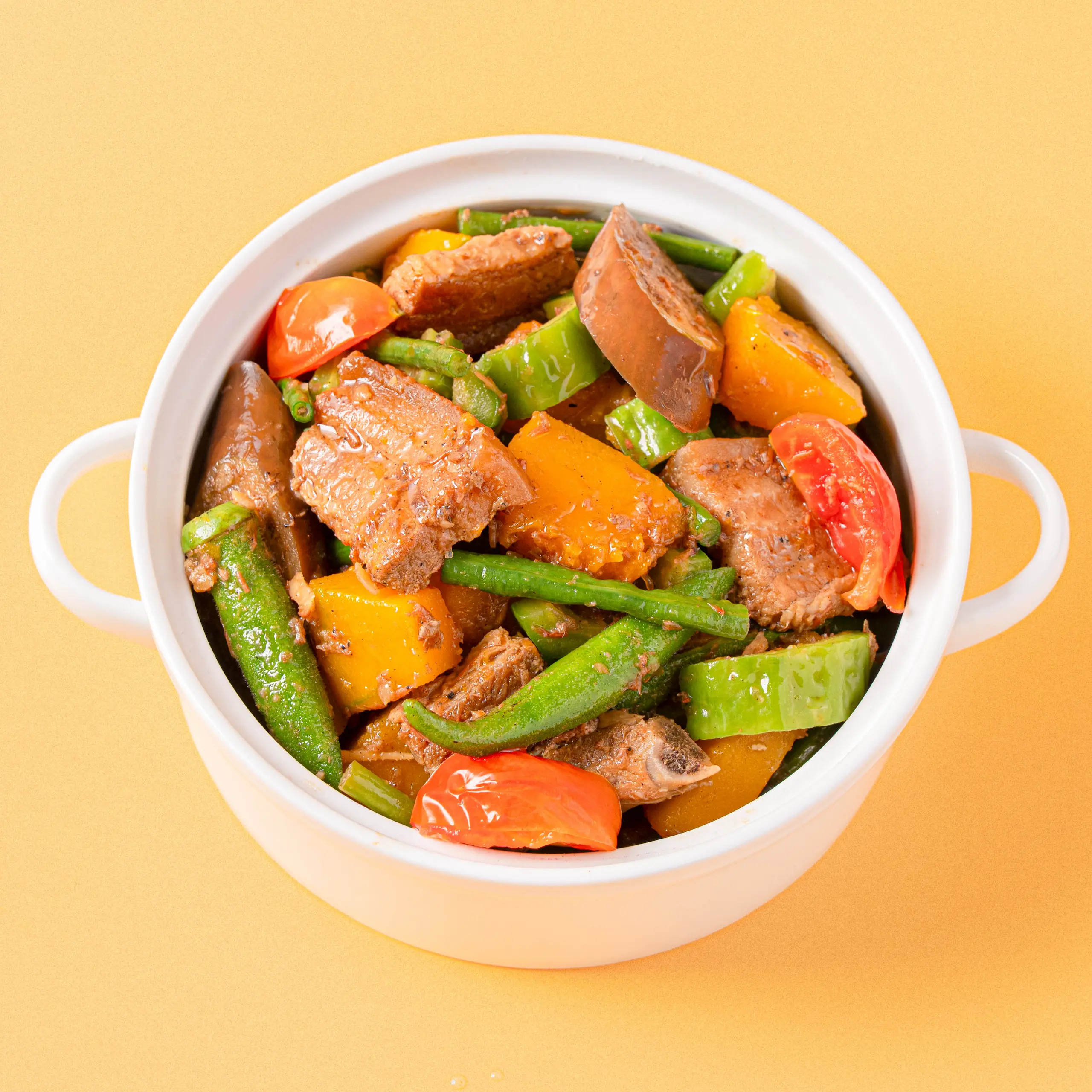


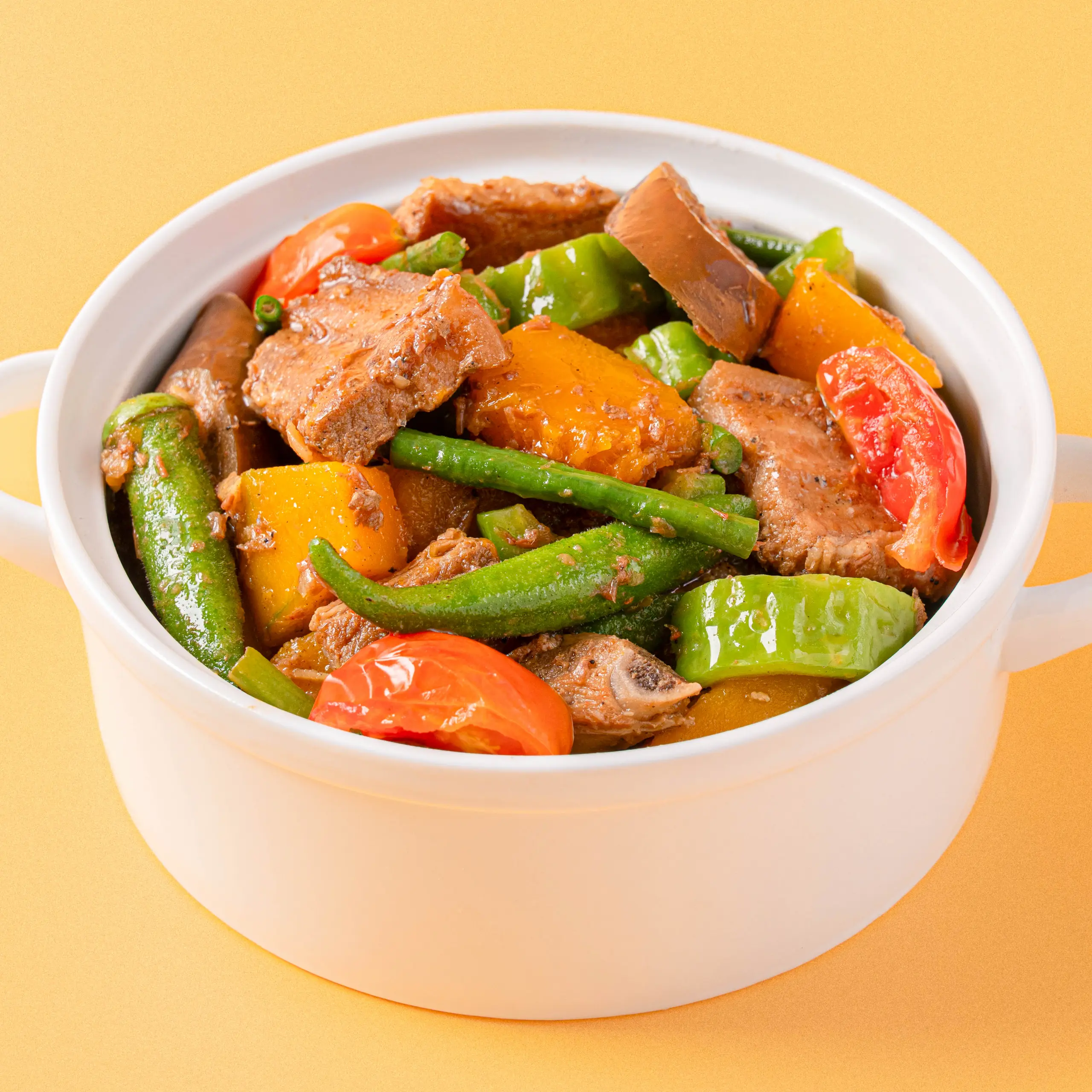
There is something wonderfully homey about a pot of Pinakbet simmering on the stove. The combination of pork, garlic, onion, tomato, shrimp paste, and fresh vegetables creates an aroma that feels unmistakably Filipino. It is the kind of food that doesn’t need an elaborate presentation. Put it beside a bowl of steaming rice, and suddenly you have a meal that feels complete.
Pinakbet is also a beautiful example of how Filipino cooking makes vegetables exciting. Instead of treating vegetables as a side dish, this recipe brings them together with savory pork and fermented shrimp paste, allowing each ingredient to contribute its own flavor and texture.
This version uses pork belly, squash, ampalaya, eggplant, string beans, tomato, and bagoong, creating a combination that is savory, slightly sweet, earthy, and pleasantly bitter. The vegetables are cooked until tender but ideally retain enough texture to keep the dish interesting.
What Is Pinakbet?
Pinakbet, also known as pakbet in some parts of the Philippines, is a traditional Filipino vegetable dish commonly associated with Ilocos and Northern Luzon.
The dish usually combines several locally available vegetables with a savory fermented seasoning such as bagoong. Depending on the region and household, the exact vegetables and cooking method can vary considerably.
Common vegetables found in different versions include:
- Ampalaya
- Eggplant
- Squash
- String beans
- Okra
- Tomatoes
- Bitter melon
- Other locally available vegetables
Some versions contain pork, while others are made almost entirely from vegetables.
That flexibility is part of Pinakbet’s charm. It was never meant to be an overly rigid recipe. Filipino families have long adapted vegetable dishes according to what was growing nearby or available in the kitchen.
A Little History of Pinakbet
Pinakbet has deep roots in Ilocano cuisine, particularly in the northern Philippines.
The word is commonly associated with the Ilocano term “pinakebbet,” which refers to vegetables cooked until they shrink or become somewhat wilted. This reflects an old and practical style of Filipino cooking in which vegetables were cooked together with strong seasonings to create a flavorful and filling meal.
Traditional Ilocano pinakbet is closely associated with bagoong isda, or fermented fish paste, rather than the sweeter shrimp paste that is sometimes used in other Filipino versions.
The dish reflects the agricultural character of Northern Luzon. Vegetables such as bitter melon, eggplant, squash, and beans were accessible to farming communities and could be combined in one pot.
Pork, when available, added richness and made the vegetable dish more substantial.
Over time, Pinakbet spread throughout the Philippines, and different regions developed their own interpretations. Some cooks use shrimp paste, some use fermented fish, some add more pork, while others prefer a mostly vegetable-based version.
So when you encounter a Pinakbet that looks slightly different from another one, that doesn’t necessarily mean one is wrong.
Pinakbet is one of those Filipino dishes where regional and family variations are part of its identity.
Recipe Tips for Really Good Pinakbet
Don’t overcook the vegetables
One of the biggest mistakes with Pinakbet is turning the vegetables into an indistinguishable soft mixture.
Different vegetables cook at different speeds.
Add the firmer vegetables first and the faster-cooking vegetables later.
The best Pinakbet usually has tender vegetables with some remaining texture.
Don’t drown it in water
Pinakbet isn’t meant to be a watery vegetable soup.
The water is there to help cook the ingredients and create a flavorful sauce.
Allow some of it to reduce.
Don’t hide the bitterness
If you are new to ampalaya, you may be tempted to remove every trace of bitterness.
But bitterness is one of the characteristics that gives Pinakbet its distinctive flavor.
Instead of eliminating it completely, balance it with the savory pork, sweet squash, tomato, and fermented seasoning.
Let the pork brown
A little browning gives the dish a deeper flavor.
If you simply boil the pork, you lose some of that roasted, savory character.
Be careful with bagoong
Shrimp paste can vary enormously in saltiness.
Start with less if you’re unfamiliar with the brand you’re using.
You can always add more.
Ingredient Substitutions
Pork Belly
You can replace pork belly with:
- Pork shoulder
- Pork butt
- Pork loin
- Ground pork
- Pork ribs
For a leaner version, pork loin works well.
For a richer and more traditional-feeling version, pork belly is excellent.
You can also omit the pork completely for a vegetable-focused Pinakbet.
Shrimp Paste
If shrimp paste isn’t available, you can use:
- Fermented fish paste
- Fish sauce
- Anchovy paste
- Soy sauce
However, the flavor will change.
Traditional Ilocano versions are particularly associated with fermented fish rather than shrimp paste, so using fish-based bagoong can give you a more northern-style flavor.
Squash
You can substitute other firm vegetables such as:
- Sweet potato
- Chayote
- Carrot
- Pumpkin
Squash is particularly useful because its natural sweetness balances the bitterness of the ampalaya.
Ampalaya
If you strongly dislike bitter melon, you can omit it.
However, the resulting dish will be less characteristic of classic Pinakbet.
You can replace it with:
- Okra
- Zucchini
- Chayote
- More eggplant
String Beans
You can use:
- Yardlong beans
- Green beans
- Snow peas
- Winged beans
The cooking time will vary slightly depending on the vegetable.
Eggplant
You can use:
- Japanese eggplant
- Chinese eggplant
- Filipino eggplant
- Regular globe eggplant
Thin Asian eggplants cook particularly quickly.
Understanding the Main Ingredients
Pork Belly
Pork belly provides richness and savory depth.
As it cooks, its fat mixes with the sauce and coats the vegetables.
This is one reason vegetable-heavy dishes like Pinakbet can taste so satisfying even though vegetables make up much of the dish.
Ampalaya
Ampalaya, or bitter melon, is famous for its distinct bitter flavor.
It is commonly used in Filipino dishes such as:
- Pinakbet
- Ginisang ampalaya
- Ampalaya with egg
- Various vegetable stews
Its bitterness may take some getting used to, but it provides a useful contrast to sweeter and richer ingredients.
Squash
Squash has a naturally sweet and creamy quality when cooked.
In Pinakbet, it balances the bitterness of the ampalaya and adds body to the dish.
Eggplant
Eggplant becomes soft and absorbent as it cooks.
It acts almost like a sponge, soaking up the savory sauce and pork juices.
This makes it one of the most flavorful vegetables in the pot.
String Beans
String beans contribute a firmer, slightly crunchy texture.
They help prevent the entire dish from becoming soft and uniform.
Tomato
Tomato provides acidity, sweetness, and moisture.
It also helps create the savory base in which the other ingredients cook.
Bagoong
Bagoong is one of the defining flavor ingredients.
Its fermented character gives Pinakbet a deep savory quality that plain salt cannot reproduce.
It may smell strong when first opened, but once cooked with the pork, garlic, onion, and vegetables, it becomes much more integrated into the dish.
Is Pinakbet Healthy?
Pinakbet can be a very nutritious Filipino meal because it contains a wide variety of vegetables.
Squash, ampalaya, eggplant, tomatoes, and string beans provide fiber, vitamins, minerals, and various plant compounds.
The pork provides protein and nutrients such as iron, zinc, selenium, and vitamin B12.
However, the nutritional profile depends greatly on the amount of pork, oil, shrimp paste, and fish sauce used.
Pork belly in particular is relatively high in fat, while bagoong and fish sauce can contribute substantial sodium.
So although Pinakbet contains many nutritious vegetables, it is still worth paying attention to portions and seasoning.
Health Benefits of the Ingredients
Squash
Squash provides dietary fiber and carotenoids, including beta-carotene in many orange-fleshed varieties.
Beta-carotene is converted by the body into vitamin A, which supports normal vision and immune function.
Ampalaya
Bitter melon provides fiber, vitamin C, and various plant compounds.
It is sometimes promoted for blood-sugar management, but it shouldn’t be treated as a replacement for medical treatment or prescribed medication.
Eggplant
Eggplant provides fiber and various antioxidant compounds, particularly in its skin.
String Beans
String beans contribute fiber, vitamin C, vitamin K, folate, and other nutrients.
Tomato
Tomatoes provide vitamin C, potassium, and the antioxidant carotenoid lycopene.
Onion and Garlic
Both contribute fiber and a variety of sulfur-containing and other plant compounds.
Pork
Pork supplies high-quality protein along with vitamin B12, zinc, selenium, and iron.
How to Make a Lighter Pinakbet
Pinakbet is already vegetable-heavy, so making it lighter can be fairly easy.
You can:
- Reduce the amount of pork belly.
- Use lean pork instead.
- Use less oil.
- Increase the vegetables.
- Reduce the shrimp paste and fish sauce.
- Use a smaller amount of salty seasoning and rely more on garlic, onion, tomato, and black pepper.
- Add extra squash, eggplant, or string beans.
You can also replace some of the pork with mushrooms or tofu.
The result won’t be exactly the same as pork belly Pinakbet, but it can still be flavorful and satisfying.
The Importance of Texture
One of the underrated pleasures of Pinakbet is the different textures in a single spoonful.
You might get:
- Soft, sweet squash
- Tender eggplant
- Slightly bitter ampalaya
- Firm string beans
- Juicy tomato
- Rich pieces of pork
This is why it is useful to avoid overcooking everything together.
Pinakbet should feel like a collection of vegetables brought together by one savory sauce rather than one completely uniform vegetable stew.
Pinakbet vs. Dinengdeng
Pinakbet is sometimes compared with dinengdeng, another vegetable dish associated with Ilocano cuisine.
They share similarities, including the use of vegetables and fermented fish seasoning, but they are prepared differently and have distinct textures and flavors.
Pinakbet is often associated with a mixture of vegetables cooked together with bagoong, while dinengdeng can involve a lighter broth and vegetables added in stages.
Both dishes demonstrate the importance of vegetables and fermented seasonings in Ilocano cooking.
What to Serve with Pinakbet
For many Filipino families, the obvious companion is steamed white rice.
The rice absorbs the savory sauce and balances the strong flavor of the bagoong.
Pinakbet can also be served alongside:
- Fried fish
- Grilled fish
- Fried chicken
- Grilled pork
- Daing
- Crispy tofu
Because Pinakbet already contains vegetables and pork, it can also stand on its own as the main dish.
A simple meal of hot rice and a bowl of Pinakbet is more than enough.
Common Mistakes to Avoid
Adding all the vegetables at once: Some will become mushy before others are cooked.
Using too much water: This dilutes the flavor.
Over-salting: Bagoong and fish sauce are already salty.
Overcooking the eggplant: It can become excessively soft and break apart.
Cooking the ampalaya until completely bland: Some bitterness is desirable.
Skipping the pork browning: Browning adds important savory depth.
Using too much bagoong: It can overpower the natural flavors of the vegetables.
A Simple Way to Understand Pinakbet’s Flavor
Pinakbet works because it combines contrasting flavors.
The pork brings richness.
The bagoong brings salty fermented umami.
The squash brings sweetness.
The ampalaya brings bitterness.
The tomato provides acidity and freshness.
The eggplant absorbs the sauce.
The string beans provide texture.
The garlic and onion create the aromatic foundation.
Rather than trying to make every ingredient taste the same, Pinakbet allows them to remain distinct while working together.
That’s one of the reasons it feels so satisfying.
How to remove the bitterness in ampalaya
The most effective way in removing the bitterness in ampalaya is to clean it well. First, slice the ampalaya in half lengthwise, remove the seeds, and scrape off the white, spongy pith inside. Cut the ampalaya into the size you will need for your recipe (for easier handling) and place in a bowl.
You have two methods you can try:
- Sprinkle salt on the ampalaya. Massage it gently so the ampalaya pieces are covered evenly in salt. The salt will help draw out the water from the ampalaya. Let it rest for 15 to 20 minutes. Rinse the ampalaya well, making sure to remove all the salt on it. You may also use a cheese cloth or tea towel to squeeze out most of the water after rinsing. But be very gentle so as not to break the pieces.
- Soak it in a warm, salt water solution. For this method, mix a tablespoon of salt into a bowl of warm water. Pour this brine solution into the bowl of ampalaya pieces and let it sit for at least 15 minutes. Rinse well. You can also place the ampalaya pieces in cold water after rinsing to help retain its crunch and color.
Final Words
Pinakbet is a wonderful reminder that Filipino food doesn’t always need meat to be the star.
Here, vegetables do much of the work. Squash becomes naturally sweet and tender, eggplant absorbs the savory sauce, string beans provide texture, tomatoes bring brightness, and ampalaya adds its unmistakable bitterness. Pork and bagoong then tie everything together with a rich, deeply savory flavor.
What makes the dish even more special is its connection to Ilocano cooking and Filipino agricultural life. It is practical food—food that makes good use of vegetables, preserves the strong flavors of fermented ingredients, and turns simple ingredients into something satisfying enough for the whole family.
And like many traditional Filipino dishes, Pinakbet doesn’t have to look exactly the same every time you make it. You can change the vegetables according to the season, use more or less pork, adjust the bagoong, or make the ampalaya more or less prominent.
The important thing is to preserve the spirit of the dish: fresh vegetables, savory fermented seasoning, and a balance of different flavors and textures.
Serve it hot with plenty of steamed rice, and don’t be afraid to spoon some of that flavorful sauce over the top.
Pinakbet is humble, hearty, colorful, and deeply Filipino—a dish that shows just how delicious vegetables can be when they’re cooked with patience, good seasoning, and a little love.