


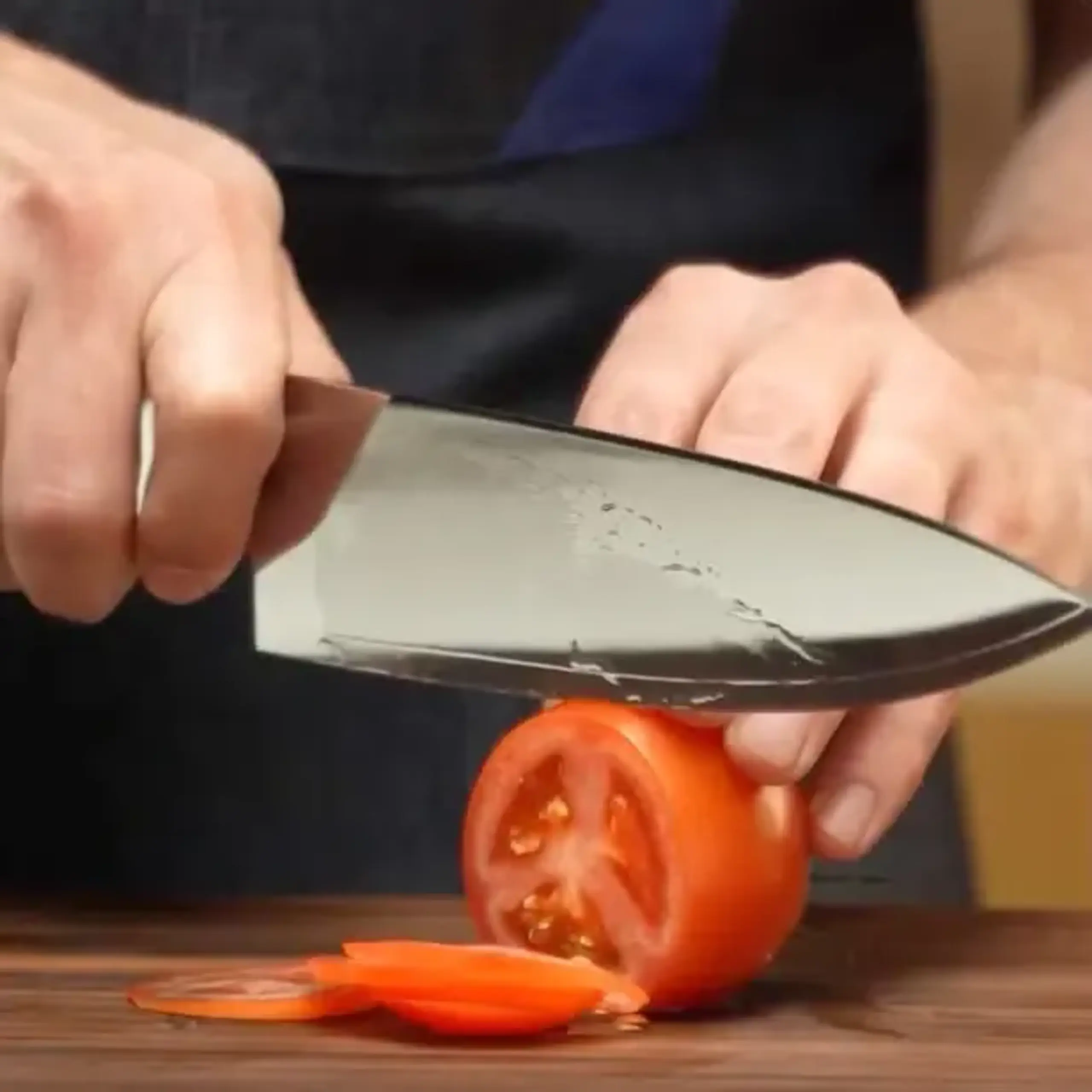
- The Ultrasonic Chef’s Knife uses 40,000 vibrations per second to dramatically reduce friction and improve slicing precision.
- Unlike traditional knives, it doesn’t rely on sharpness alone—it cuts with less force, glides through food, and prevents sticking.
- After testing, it proves to be both a revolutionary cutting tool when powered on and a solid, reliable knife when used manually.
If 40,000 vibrations a second doesn’t spin your brain, I am not sure what would. That was the sell for me. 40,000 vibrations a second. Meet the Ultrasonic Chef’s Knife, the latest wonder conceived and developed by Seattle Ultrasonics’ Scott Heimendinger.
The Ultrasonic is what you get when you combine 15 years of research, resilience, and testing with Heimendinger’s unquestionably innovative mind. The goal was not another forgettable iteration of a tricked-out air fryer, gussied-up stove, or another piece of “smart”-enabled kitchen equipment. His focus was on the chef’s knife. The modern chef’s knife is centuries old but has never, in earnest, been reimagined. It’s the most utilized, fetishized thing you use in a kitchen.
Never a dull moment—or a dull knife
It is also the most angst-inducing. You, me, everyone knows what a dull knife is. (Close your eyes and picture trying to slice a tomato with something that could be mistaken for a butter knife. Not a nice thought.) One reason why the Ultrasonic is so ruthlessly effective is that it doesn’t rely on sharpness; it leans on the energy generated by those vibrations. The Ultrasonic behaves sharper than it is. In addition, it requires half the force of a conventional knife.
So I had to try it out. First order of business: slicing a potato. While depressing the button to activate the knife (the knife is rechargeable and comes with a battery pack), the slices glided off the knife with ease. And that’s another thing—cut potatoes tend to stick to a blade, but not here. Those vibrations reduceReduceA cooking technique in which a liquid is simmered until some of the water evaporates, thickening its texture and concentrating its flavor. Home cooks reduce sauces, stocks, and glazes, andGo to Reduce Glossary friction so much that the slices fell right off. Next were a bell pepper and a tomato. I don’t have to tell you, but I will anyway, that the Ultrasonic performed miraculously.
If you can’t abide a dull knife and the thought of sharpening it, the Ultrasonic is your kitchen game changer. By the way, when it’s off, it’s an excellent knife too.
This article was originally published in Delish US.

Frequently Asked Questions
While traditional knives rely entirely on the sharpness of the edge and physical downward pressure, the Ultrasonic Chef’s Knife uses energy from 40,000 vibrations per second. These vibrations dramatically reduce friction, allowing the blade to behave sharper than it actually is and requiring only half the force of a conventional knife.
No. One of the biggest advantages noted during testing is that the high-frequency vibrations prevent food from clinging to the metal. Ingredients that typically stick to blades, like sliced potatoes, glide right off the surface and fall onto the cutting board with ease.
The knife was developed by Scott Heimendinger of Seattle Ultrasonics. It is the result of 15 years of research and innovation aimed at reimagining the most essential tool in the kitchen—the chef’s knife—which has remained largely unchanged for centuries.
Yes. Even when the power is turned off or the battery pack is depleted, the tool remains an excellent, high-quality knife that can be used manually like any other professional chef’s knife in your collection.
Absolutely. Because the knife relies on ultrasonic energy to cut through surfaces rather than just a razor-thin edge, it is a game-changer for those who dislike the maintenance of constant sharpening. It provides a “miraculous” cut on difficult items like tomatoes and bell peppers even if the blade isn’t perfectly honed.