


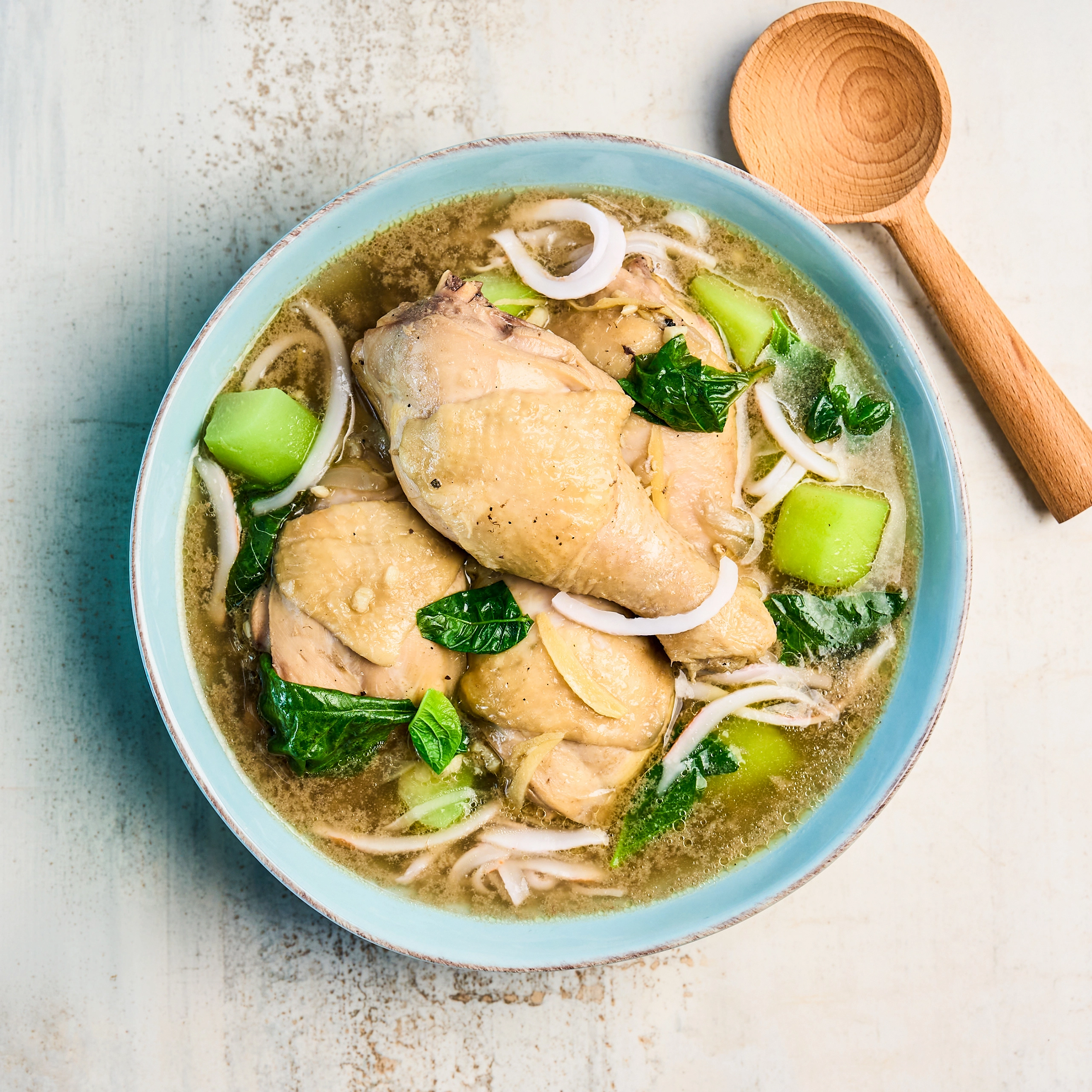
Some Filipino dishes are memorable because they are rich and heavy, while others win you over through simplicity. Chicken Binakol belongs to the second group. It is a comforting chicken soup built around one of the Philippines’ most familiar ingredients: coconut.
Imagine a pot gently simmering with chicken, ginger, lemongrass, coconut water, shredded coconut, and vegetables. The aroma is fresh and soothing, with the ginger providing warmth and the coconut water giving the broth a naturally mild sweetness. It is the kind of dish that feels especially welcome on a quiet family lunch, when someone at home is craving something warm, nourishing, and uncomplicated.
This Iloilo-style version combines tender chicken with fresh coconut water, young coconut meat, chayote, and kangkong. Unlike heavily seasoned soups, binakol allows the natural flavors of its ingredients to remain noticeable. The broth is delicate, aromatic, and slightly sweet rather than aggressively salty or spicy.
What makes it particularly special is the way the coconut is used. Coconut isn’t merely a garnish or creamy addition—it becomes part of the identity of the dish. Coconut water forms the foundation of the broth, while shredded coconut contributes texture and a gentle richness.
If you’ve never cooked binakol before, don’t be intimidated by its simplicity. This is exactly the kind of Filipino dish where patience and good ingredients do most of the work.
A Little History of Chicken Binakol
Binakol is traditionally associated with the Western Visayas and Panay region, including Iloilo and neighboring areas, and is part of the broader family of Filipino chicken soups that use local aromatics and coconut.
Its name and preparation are often discussed alongside other regional dishes that make use of coconut water and young coconut. As with many Filipino regional recipes, versions can differ from one household or locality to another. Some preparations use coconut meat generously, while others may include different vegetables or cuts of chicken.
The use of coconut is particularly meaningful in Philippine cooking. Coconut palms thrive in the country’s tropical climate, and practically every part of the coconut has historically found a place in Filipino food and everyday life.
Coconut water can be enjoyed as a drink, coconut meat can be eaten fresh or incorporated into dishes, and coconut milk can turn savory foods into rich stews and soups.
Binakol showcases that versatility beautifully.
Rather than masking the chicken with a thick sauce or a large number of spices, the dish allows the ingredients to speak for themselves. Ginger and lemongrass provide fragrance, fish sauce supplies savory depth, coconut water adds subtle sweetness, and young coconut contributes a soft, pleasantly chewy texture.
This is part of what makes regional Filipino cooking so fascinating: the recipe is often shaped by what grows locally.
What Is Chicken Binakol?
Chicken binakol is a Filipino chicken soup cooked with coconut water and coconut meat.
At first glance, it may remind you of other Filipino chicken soups, especially dishes that use ginger, onion, and fish sauce. But the coconut water gives binakol a distinct character.
Instead of using ordinary water as the sole liquid, coconut water forms the main broth. As the chicken cooks, its savory juices combine with the naturally sweet coconut water, creating a balanced soup.
The addition of shredded unsweetened coconut provides a little texture and reinforces the coconut flavor without making the soup overwhelmingly rich.
Chayote contributes a mild, juicy crunch, while kangkong adds a fresh green element near the end of cooking.
The result is a soup that is:
- Light but flavorful
- Aromatic
- Naturally savory and slightly sweet
- Comforting without being overly heavy
- Rich in coconut flavor without requiring coconut cream
Recipe Tips for Better Chicken Binakol
Use fresh coconut water when possible
Fresh coconut water gives the broth a particularly clean and naturally sweet flavor.
If using packaged coconut water, choose an unsweetened variety without added flavorings.
Avoid coconut water beverages that contain added sugar because they can make a savory soup taste unexpectedly sweet.
Don’t replace coconut water with coconut milk
Coconut water and coconut milk have completely different characteristics.
Coconut water is light and refreshing, while coconut milk is creamy and rich.
Using coconut milk will create a different dish rather than simply replacing one ingredient.
Don’t skip the ginger
The generous amount of ginger is not accidental.
Ginger helps give the broth its aromatic backbone and balances the richness of the chicken and coconut.
If you’re sensitive to ginger, you can reduce it, but removing it completely will noticeably change the dish.
Bruise the lemongrass
Don’t simply drop whole, untouched stalks into the pot.
Give them a gentle crush with the side of your knife first. This helps release the fragrant oils into the broth.
Tie the stalks together if you want them to be easier to remove later.
Don’t overcook the chayote
Chayote is best when tender but still holds its shape.
Adding it too early can result in very soft pieces that break apart into the broth.
Add kangkong last
Leafy greens cook quickly.
Adding kangkong near the end keeps it fresher in appearance and prevents it from becoming excessively soft.
Taste before adding salt
Fish sauce is already salty.
Always taste the broth first before adding additional salt.
Ingredient Substitutions
One of the advantages of binakol is that it can be adapted when certain ingredients aren’t available.
Chicken drumsticks → Chicken thighs
Chicken thighs are an excellent substitute.
Boneless thighs can also be used if you prefer easier eating, although bone-in chicken contributes additional flavor to the broth.
Drumsticks → Whole chicken pieces
You can use a combination of thighs, wings, breast, or other chicken pieces.
Bone-in pieces generally produce a more flavorful broth.
Fresh coconut water → Unsweetened bottled coconut water
This is the easiest substitution.
Choose plain coconut water without added sugar or fruit flavoring.
Fresh coconut → Young coconut meat
If you can find fresh young coconut meat, it can be sliced or shredded and used in place of the shredded coconut.
This can give the dish a softer, more delicate coconut texture.
Chayote → Green papaya
Green papaya can work well as a substitute for chayote.
It has a somewhat different texture, but it is similarly mild and works beautifully in Filipino soups.
Kangkong → Pechay
Pechay or bok choy can be used if kangkong isn’t available.
The flavor will be different, but the greens still provide freshness and color.
Kangkong → Spinach
Spinach is another practical substitute, especially outside the Philippines.
Add it very close to the end because spinach wilts quickly.
Fish sauce → Salt
If you don’t eat fish or don’t have fish sauce, you can season with salt instead.
However, fish sauce provides a deeper savory quality, so the final broth will taste somewhat simpler.
For a vegetarian adaptation, mushroom seasoning or a vegetarian fish-sauce alternative can provide additional umami.
Understanding the Role of Each Ingredient
Chicken
Chicken provides the primary protein and savory foundation of the soup.
Using bone-in drumsticks also allows the bones, connective tissue, and meat to contribute flavor as the soup simmers.
Coconut Water
Coconut water is what gives binakol much of its personality.
It has a naturally mild sweetness and refreshing quality that distinguishes the dish from soups made with plain water or stock.
Coconut Meat
Shredded coconut contributes texture and a subtle richness.
Unlike coconut milk, it doesn’t turn the entire broth creamy.
Instead, you get little pieces of coconut throughout the soup.
Ginger
Ginger adds warmth and fragrance.
It also provides a pleasant contrast to the mild sweetness of coconut water.
Lemongrass
Lemongrass contributes citrusy, floral notes.
It helps keep the broth tasting fresh rather than heavy.
Fish Sauce
Fish sauce provides salt as well as umami.
A relatively small amount can make the broth taste significantly more complex.
Chayote
Chayote is mild, slightly sweet, and juicy.
It absorbs some of the flavor of the broth while maintaining its own subtle texture.
Kangkong
Kangkong brings a fresh, leafy quality to the soup and adds another texture to the dish.
Health Benefits of the Ingredients
Chicken binakol contains several nutritious ingredients, although its overall nutritional profile will depend on the chicken cut, amount of oil, serving size, and other ingredients used.
Chicken
Chicken is a good source of high-quality protein.
It also provides nutrients such as vitamin B6, selenium, phosphorus, and niacin.
Removing the chicken skin can reduce the amount of fat if you’re looking for a leaner version.
Ginger
Ginger contains naturally occurring compounds such as gingerols.
It has been studied for its potential antioxidant and anti-inflammatory properties and is traditionally used to support digestion and ease nausea.
In binakol, though, its most immediate contribution is flavor.
Coconut Water
Coconut water contains water and naturally occurring electrolytes, including potassium.
It also contains natural sugars, which contribute to its mild sweetness.
It shouldn’t be considered a replacement for medical electrolyte treatments, but it can be a refreshing ingredient in everyday cooking.
Coconut
Coconut meat contains fiber and fats, as well as minerals such as manganese and copper.
It is also energy-dense, so generous portions can substantially increase the calorie content of the dish.
Chayote
Chayote is a relatively light vegetable and provides fiber, vitamin C, folate, and other micronutrients.
It also adds volume to the soup without making it particularly heavy.
Kangkong
Water spinach provides vitamins, minerals, and plant compounds.
Like many leafy green vegetables, it can contribute to a diet rich in vegetables and fiber.
Lemongrass
Lemongrass contains aromatic plant compounds and contributes very little energy in the small quantity used in cooking.
Its greatest role here is its fragrant citrus-like flavor.
A Note About the Soup’s Overall Healthfulness
Binakol can fit comfortably into a balanced diet because it combines protein, vegetables, and a flavorful broth.
However, fish sauce and added salt can make the sodium content relatively high. If you’re watching sodium intake, use less fish sauce and rely more on ginger, lemongrass, garlic, pepper, and the natural flavor of the coconut water.
How to Store Chicken Binakol Properly
Because binakol contains cooked chicken and coconut products, proper storage is important.
Don’t leave the finished soup sitting at room temperature for an extended period.
Once you’ve finished serving, allow the soup to stop steaming heavily and transfer it into shallow containers. Refrigerate it promptly.
Dividing a large pot into smaller containers helps it cool more quickly.
Avoid putting a very large, deep pot of hot soup directly into the refrigerator because it can cool too slowly.
Refrigerator
Store the soup in airtight containers and refrigerate.
For best safety and quality, consume refrigerated cooked chicken soup within 3–4 days.
If you know you won’t finish it within that time, freezing is a better option.
Freezer
Binakol can be frozen, although the texture of the vegetables and coconut may change somewhat after thawing.
Let the soup cool appropriately, portion it into freezer-safe containers, leave some space for expansion, and label each container with the date.
For best quality, use frozen binakol within approximately 2–3 months.
How to Reheat Chicken Binakol
Reheat only the amount you intend to eat.
Stovetop
Pour the soup into a saucepan and heat gently until steaming hot throughout.
Stir occasionally to distribute the heat evenly.
Avoid boiling it aggressively for a long time, as this can make the chicken drier and the vegetables softer.
Microwave
Place a serving in a microwave-safe bowl.
Cover loosely to prevent splattering and heat in intervals, stirring between intervals when practical.
Make sure the chicken and broth are thoroughly hot before serving.
From Frozen
For the best results, thaw the soup overnight in the refrigerator before reheating.
If reheating directly from frozen, use low heat initially and stir as the soup loosens.
Shelf Life of Chicken Binakol
For practical home storage:
- Room temperature: Serve promptly and avoid leaving cooked chicken soup unrefrigerated for more than about 2 hours; in very hot conditions, the safe window can be shorter.
- Refrigerator: Approximately 3–4 days.
- Freezer: Approximately 2–3 months for best quality.
- Leftover reheated soup: Refrigerate promptly after serving and avoid repeatedly heating and cooling the entire batch.
If the soup develops an unpleasant odor, unusual appearance, mold, or a slimy texture, discard it.
When food has been stored improperly, don’t rely on smell or taste alone to determine whether it is safe.
How to Make Binakol Ahead of Time
Binakol can be a very convenient make-ahead meal.
You can cook the chicken and broth ahead of time and refrigerate it.
When you’re ready to serve, gently reheat the soup and add fresh kangkong near the end.
This approach can help preserve the texture and color of the greens.
If you’re cooking for a family gathering, prepare the soup earlier in the day and reheat it gently shortly before serving.
How to Serve Chicken Binakol
Chicken binakol is satisfying on its own, but it becomes an even more complete Filipino meal with steamed rice.
Serve it with:
- Steamed white rice
- Garlic rice
- Fresh tomatoes
- Cucumber slices
- Atchara
- Grilled or fried fish
- Simple vegetable dishes
- Calamansi on the side
A little calamansi can add brightness if you enjoy a more acidic contrast, although it isn’t necessary for the dish.
Because the broth is relatively delicate, avoid overwhelming it with very strong side dishes.
What Makes Chicken Binakol Different from Tinola?
It’s easy to compare binakol with tinola, since both are Filipino chicken soups that commonly use ginger and leafy greens.
The major difference is the broth.
Tinola is generally built around water or stock and commonly includes ingredients such as green papaya or chayote and chili leaves or other greens.
Binakol, on the other hand, is distinguished by its use of coconut water and coconut meat.
Both dishes are comforting and aromatic, but binakol has a naturally sweeter, more coconut-forward character.
If you’ve grown up eating tinola, binakol can feel familiar while still offering something completely different.
Final Thoughts
Chicken binakol is proof that a dish doesn’t have to be complicated to be deeply satisfying.
A handful of ingredients—chicken, ginger, lemongrass, coconut water, coconut meat, chayote, and greens—come together to create a soup with remarkable depth.
The coconut water gives the broth its signature character, while ginger and lemongrass keep the flavor fragrant and lively. The chicken makes the soup hearty, the chayote adds a tender vegetable component, and kangkong brings a fresh green finish.
What I love most about binakol is how naturally it reflects the Filipino relationship with coconut. The coconut isn’t treated as an occasional specialty ingredient. It is something that can become a drink, a broth, a vegetable component, a seasoning, and so much more.
This is also a dish that rewards patience. Let the chicken simmer gently. Give the aromatics time to release their fragrance. Taste the broth before adding more salt. Add the vegetables at the right moment. These small decisions are what turn a simple pot of ingredients into a comforting meal.
And when you finally sit down with a steaming bowl of binakol and some freshly cooked rice, you get something that feels wonderfully familiar: warm, nourishing, aromatic, and unmistakably Filipino.
Whether you’re from Iloilo, elsewhere in the Visayas, or simply someone discovering regional Filipino cuisine for the first time, Chicken Binakol is worth making.
It’s a humble dish with a beautiful story—and sometimes, those are the recipes that deserve the most space on our tables.
Parang tinola. Try ko to!