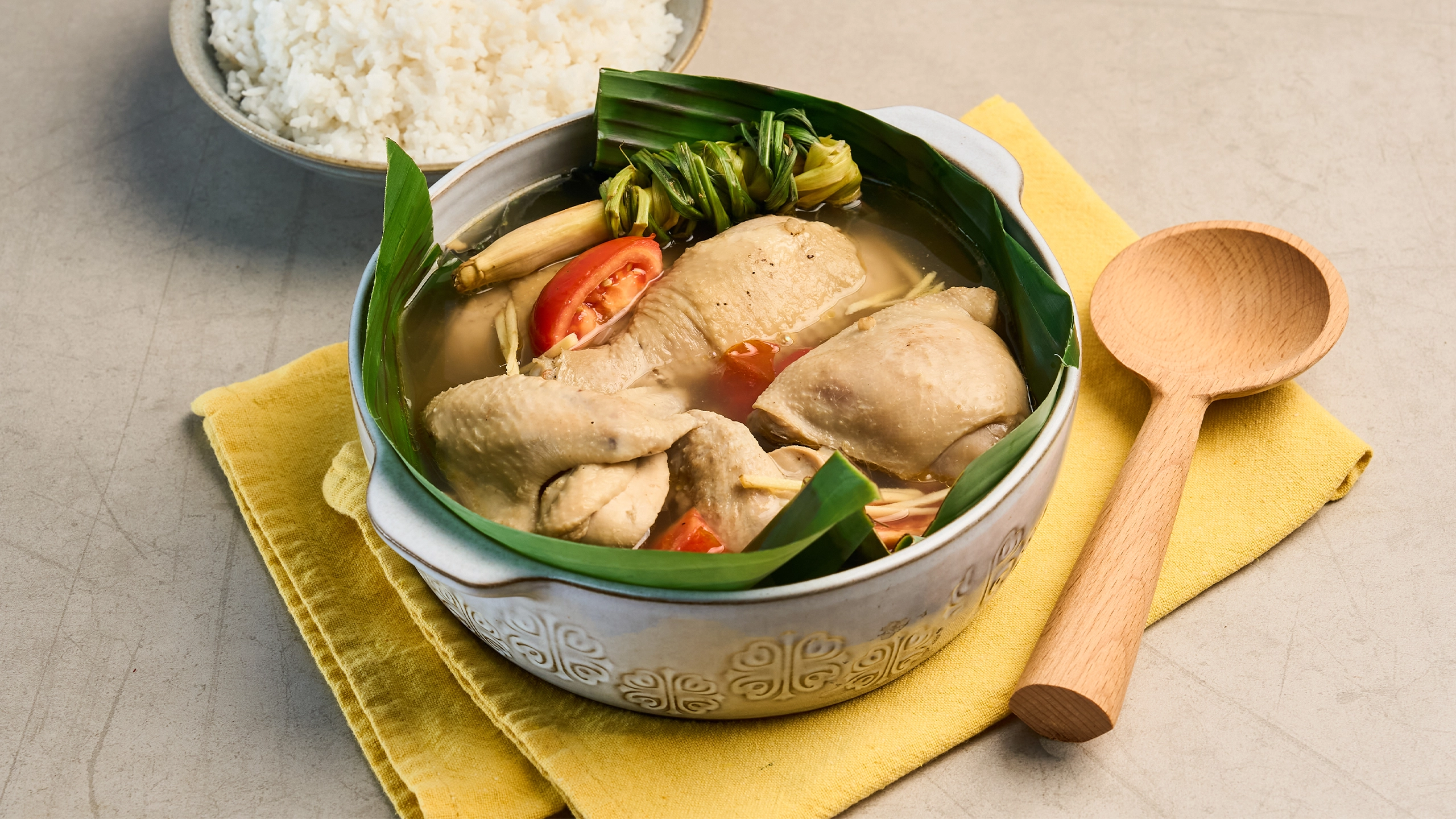


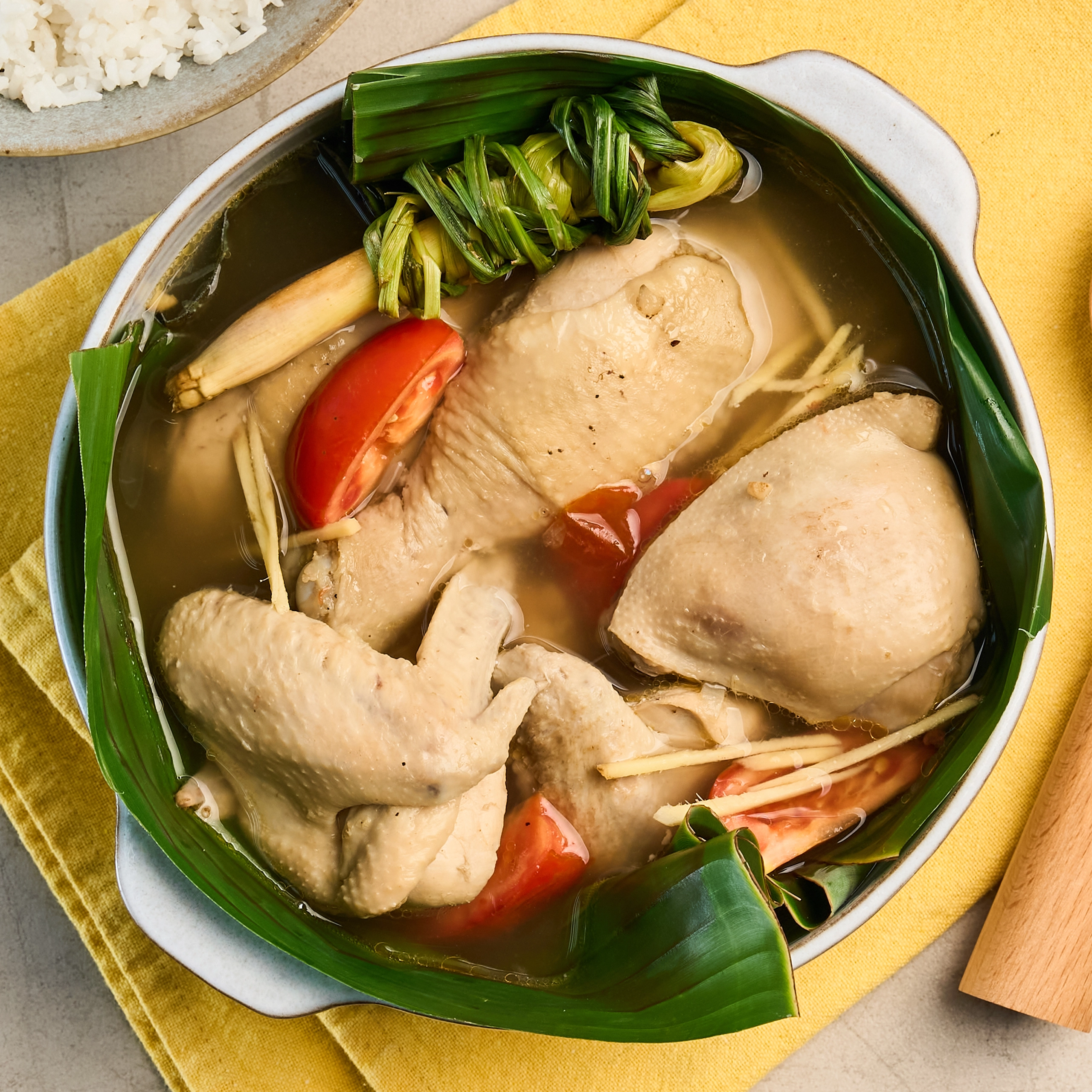
There is something wonderfully comforting about Tinuom. At first glance, it may look like a simple chicken soup, but the moment the banana-leaf pouch is opened, the character of the dish becomes clear. The steam carries the fragrance of lemongrass, ginger, tomatoes, and chicken, while the broth inside the parcel is warm, savory, and deeply aromatic.
Tinuom is an Ilonggo dish strongly associated with Cabatuan, Iloilo, where it has become an important part of the town’s culinary identity. The name is connected with the traditional practice of wrapping the ingredients in banana leaves before cooking. The dish is traditionally made with native chicken, aromatics, and banana leaves, although versions can differ from one household or municipality to another.
What makes Tinuom special is not an elaborate list of ingredients. It is the cooking method. The chicken and seasonings are enclosed in banana leaves, allowing the flavors to mingle in their own juices and broth. It is a wonderful example of how traditional Filipino cooking can turn humble ingredients into food with a strong sense of place and memory.
The recipe you provided includes sautéing the aromatics and chicken before the banana-leaf wrapping. This gives the dish a slightly richer, more developed flavor while retaining the distinctive banana-leaf aroma.
A Little History of Tinuom
Tinuom is more than simply a recipe from Iloilo. It is part of the culinary heritage of Cabatuan, where the dish has been passed down through generations and remains associated with family gatherings, fiestas, community celebrations, and local food culture. The University of the Philippines Visayas’ Cultural Mapping of Panay and Guimaras identifies Tinuom as an intangible cultural heritage practice in Cabatuan, noting that preparation knowledge is commonly transmitted through observation and hands-on participation.
The dish was historically prepared at home, but it eventually became popular outside households through local eateries. One of the best-known examples is Leah’s Tinuom, whose history is connected with the Lopera-Retotar family and the popularization of Tinuom in Cabatuan. Sources differ slightly on the details of the establishment’s early history, but accounts consistently place its roots in the mid-20th century and describe the dish as an important part of the family’s livelihood and culinary legacy.
Tinuom has also become a symbol of Cabatuan’s local identity. The town celebrates the dish through its Tinuom Festival, helping preserve not only the food itself but also the knowledge, techniques, and community traditions surrounding it.
Interestingly, Tinuom does not have to be limited to chicken. Traditional accounts describe variations using other ingredients, including fish and mushrooms. Still, Tinuom nga Manok, particularly when made with native chicken, is the version most strongly associated with Cabatuan.
How to Make Tinuom
1. Prepare the banana leaves
Start by cleaning the banana leaves thoroughly. Pass them briefly over a low flame or dip them in hot water until they become soft and flexible.
This step is important because fresh banana leaves can crack when folded. Gently wilting them makes them easier to shape into a pouch.
Traditional cooks in Cabatuan have emphasized the importance of the banana leaves themselves, particularly Saba or Manilan-on leaves, because the leaves contribute aroma and help protect the broth from leaking.
2. Prepare the aromatics
Heat the oil in a large pot over medium heat.
Add the garlic, onion, and ginger. Sauté for about 2–3 minutes, or until the onion softens and the aromatics become fragrant.
Do not brown the garlic too aggressively. You want a fragrant base rather than a bitter one.
3. Add the chicken
Add the chicken pieces and cook until the exterior begins to change color and develops a very light golden appearance.
Add the quartered tomatoes and stir gently. As they soften, they will release their juices into the mixture.
The tomatoes are particularly useful here because they add mild acidity and natural sweetness, balancing the savory chicken and sharpness of the ginger.
4. Add the water and seasonings
Pour in the water and add the lemongrass.
Season with salt and pepper. Bring the mixture to a gentle simmer.
For this particular recipe, you do not need to boil the chicken aggressively. A gentle cooking process produces a more pleasant broth and helps keep the chicken tender.
5. Prepare the Tinuom pouch
Lay two pieces of wilted banana leaf across one another, forming a cross.
Place a portion of chicken, tomatoes, garlic, onion, ginger, and lemongrass in the center.
Spoon some of the broth into the pouch. Don’t overfill it—the parcel needs enough room to be gathered and tied securely.
Bring the edges of the banana leaves upward and gather them at the top.
Tie the pouch securely with kitchen twine, bamboo string, or an appropriate strip of banana-leaf fiber.
The parcel needs to be tight enough to hold the broth but not so tight that the leaves tear.
6. Cook the wrapped chicken
Place the banana-leaf parcels into a pot or steamer.
If steaming, cook until the chicken is tender and fully cooked. Traditional and contemporary preparations vary: some versions are boiled while others are steamed. A recent Philippine Information Agency account of Cabatuan’s traditional preparation describes steaming the wrapped parcels for roughly 20–30 minutes, while other traditional accounts use boiling and allow more time depending on the age of the chicken.
If you’re using native chicken, allow extra cooking time if necessary. Native chicken tends to be leaner and firmer than commercial broiler chicken.
7. Open and serve
Carefully transfer the cooked parcel to a serving bowl.
Open the banana leaves at the table if possible. This is part of the pleasure of eating Tinuom—the fragrance escapes as the leaves are opened.
Serve the chicken with plenty of its hot broth and enjoy it with freshly cooked rice.
Recipe Tips for Better Tinuom
Wilt the banana leaves first. This is probably the most important preparation trick. Flexible leaves are much less likely to crack or leak.
Use two layers of leaves. A double layer gives the parcel additional strength, particularly when you are adding broth.
Do not overfill the pouch. Leave enough space at the top to gather and tie the leaves securely.
Bruise the lemongrass. Give the stalk a gentle smash with the back of your knife. This helps release its citrusy aroma.
Use ripe but firm tomatoes. Very underripe tomatoes can be too acidic, while overly soft tomatoes can make the mixture watery.
Keep the cooking gentle. A violent boil can make the broth cloudy and can cause the parcel to move around too much.
Don’t discard the broth. The liquid is one of the best parts of Tinuom. It carries the flavor of the chicken, tomatoes, ginger, onion, garlic, and lemongrass.
Give native chicken enough time. Native chicken has a firmer texture than broiler chicken. It rewards slower cooking.
Ingredient Substitutions
Native chicken
Native or free-range chicken is ideal because it provides the firmer texture and more pronounced flavor traditionally associated with Tinuom. However, regular chicken can be used when native chicken is unavailable. Contemporary recipe guidance likewise recommends broiler chicken as a practical substitute, with a shorter cooking time to prevent it from becoming too soft.
Banana leaves
Fresh banana leaves are the best choice because they provide the characteristic aroma and presentation.
If they are unavailable, parchment paper can be used to create a pouch. Aluminum foil can also function as a practical cooking wrapper, but these substitutes will not provide the same fragrance as banana leaves.
Native tomatoes
Regular ripe tomatoes work perfectly well if native tomatoes aren’t available. Choose flavorful, ripe tomatoes rather than pale or underripe ones.
Lemongrass
If fresh lemongrass isn’t available, you can omit it, although the finished dish will lose some of its characteristic citrusy aroma. Avoid replacing it with a large amount of lemon juice; the two ingredients contribute very different flavors.
Fresh ginger
Fresh ginger is strongly recommended. In a pinch, ground ginger can provide some warmth, but it will not reproduce the fresh, aromatic quality of julienned ginger.
Cooking oil
Canola, vegetable, sunflower, or other neutral cooking oils can be used. The oil is mainly there to sauté the aromatics and chicken, so you don’t need an intensely flavored oil.
What Makes Tinuom Different?
Tinuom’s appeal comes from the combination of ingredients and enclosure.
When the chicken is wrapped in banana leaves, the parcel creates a small cooking environment where steam, broth, chicken juices, and aromatic ingredients interact. Instead of allowing all the aroma to escape immediately into a large pot, much of it remains concentrated inside the parcel.
The banana leaf itself is also important. It doesn’t simply serve as attractive packaging. Its aroma becomes part of the experience of the dish. This is why traditional cooks place importance on the quality and type of banana leaves used.
The method also reflects a broader characteristic of traditional Filipino cuisine: making good use of ingredients that are readily available in the local environment. Research on Tinuom preparation in Iloilo describes it as a traditional cooking technique in which mixed ingredients are wrapped in banana leaves, with variations developing among different municipalities and households.
Health Benefits of the Ingredients
Tinuom is not necessarily a “health food” in the strict dietary sense, but many of its individual ingredients provide useful nutrients.
Chicken provides high-quality protein, which is important for maintaining muscles and supporting normal body functions. Native chicken can also be relatively lean, although the nutritional profile depends on the cut and cooking method.
Tomatoes contain vitamin C, potassium, and the antioxidant lycopene. Cooking tomatoes can make lycopene more available to the body.
Ginger contains naturally occurring compounds such as gingerols and is traditionally valued for its warming and digestive qualities. It also contributes a great deal of flavor without requiring a large amount of salt.
Garlic contains sulfur-containing compounds and contributes flavor, allowing you to build a satisfying dish without relying heavily on commercial seasonings.
Onions provide vitamin C and various plant compounds while supplying natural sweetness when cooked.
Lemongrass contributes aromatic plant compounds and allows the dish to have a bright citrus-like character without adding sugar.
Banana leaves are primarily a cooking and wrapping ingredient rather than a major source of nutrition in the finished dish. Their important contribution is the aroma, traditional presentation, and cooking method.
For a lighter version, you can reduce the oil and use skinless chicken pieces. Just remember that the final nutritional value will depend on the chicken cut, amount of oil, salt, and serving size.
How to Store Tinuom Properly
Because Tinuom contains cooked chicken and broth, leftovers should be treated like other cooked poultry dishes.
If you are not eating it immediately, transfer the cooked chicken and broth to clean, shallow airtight containers and refrigerate promptly rather than leaving the dish at room temperature for an extended period.
For the best quality, eat refrigerated Tinuom within about 3 days. A recent recipe guide for this dish also recommends refrigeration for up to three days.
If you have a large quantity, divide it into smaller containers before refrigerating. This helps it cool more efficiently.
You can also freeze Tinuom if you want to keep it longer. Remove the chicken from the banana leaves and store it with its broth in a freezer-safe airtight container. Leave a little room for expansion.
For best quality, use frozen leftovers within roughly 2–3 months, although continuously frozen food can remain safe longer when kept at proper freezer temperature; quality is the main concern over time.
How Long Does Tinuom Last?
As a practical guide:
- At room temperature: Don’t leave cooked chicken sitting out for more than about 2 hours; reduce that to about 1 hour in very hot conditions.
- Refrigerated: Best consumed within 3 days.
- Frozen: Best quality within about 2–3 months.
- Reheated: Reheat only the portion you intend to eat and make sure the chicken and broth are thoroughly hot.
If the leftovers develop an unusual smell, slimy texture, mold, or other obvious signs of spoilage, discard them rather than trying to rescue them.
The Best Way to Reheat Tinuom
The gentlest method is to reheat the chicken together with some of its broth in a covered pot over low to medium-low heat.
If the chicken is still wrapped, you can also steam the parcel until heated through. This helps preserve moisture and brings back some of the banana-leaf aroma.
Avoid repeatedly reheating and cooling the entire batch. Portioning the leftovers before storage makes this much easier.
How to Serve Tinuom
Tinuom is naturally suited to a simple Filipino meal.
Serve it with:
- Steamed white rice
- Extra broth
- Sliced tomatoes
- Calamansi on the side
- A little chili for those who enjoy heat
- A simple vegetable side dish
The broth is especially good spooned over hot rice. You don’t need a complicated side dish because Tinuom already has a combination of protein, vegetables, aromatics, and flavorful broth.
A Few Traditional Details Worth Remembering
One of the most interesting things about Tinuom is that there isn’t necessarily one single “correct” recipe.
Different parts of Iloilo have their own approaches. A Central Philippine University case study documented differences in preparation among municipalities in Iloilo’s third district, showing how local cooks adapt the dish according to ingredients, techniques, and household practices.
That is important when preparing traditional food. A recipe can have a recognizable identity without every household measuring everything exactly the same way.
Some traditional versions are extremely simple, relying primarily on native chicken, onion, tomato, lemongrass, salt, water, and banana leaves. Other modern versions introduce garlic, ginger, oil, pepper, or other seasonings.
So if your grandmother’s Tinuom tastes slightly different from someone else’s, that doesn’t necessarily mean one of them is wrong. That variation is part of how food traditions stay alive.
Final Thoughts
Tinuom is a beautiful example of Iloilo’s food culture because it doesn’t try to impress through extravagance. Its strength comes from simplicity: good chicken, fresh aromatics, tomatoes, lemongrass, water, and banana leaves.
But there is also something emotional about the way it is cooked. The ingredients are gathered together, wrapped carefully, tied into a small parcel, and slowly cooked until everything becomes one fragrant dish. When the banana leaves are finally opened, the steam releases the aroma that has been trapped inside.
That simple moment captures what makes Tinuom special.
It is food wrapped in leaves, but also food wrapped in tradition—a dish connected to Cabatuan, Iloilo, family kitchens, community gatherings, local farmers, and generations of cooks who learned not just by reading a recipe, but by watching someone else prepare it. Tinuom’s continued presence in Iloilo’s cultural celebrations shows that preserving a dish can also mean preserving a piece of a community’s identity.
And perhaps that is the best reason to make it: not simply because Tinuom is delicious, but because every banana-leaf parcel carries a little piece of Ilonggo culinary history.