Advertisement

5 Techniques on How to Devein Your Shrimp

Here's everything you need to know about cleaning shrimp like a pro at home.

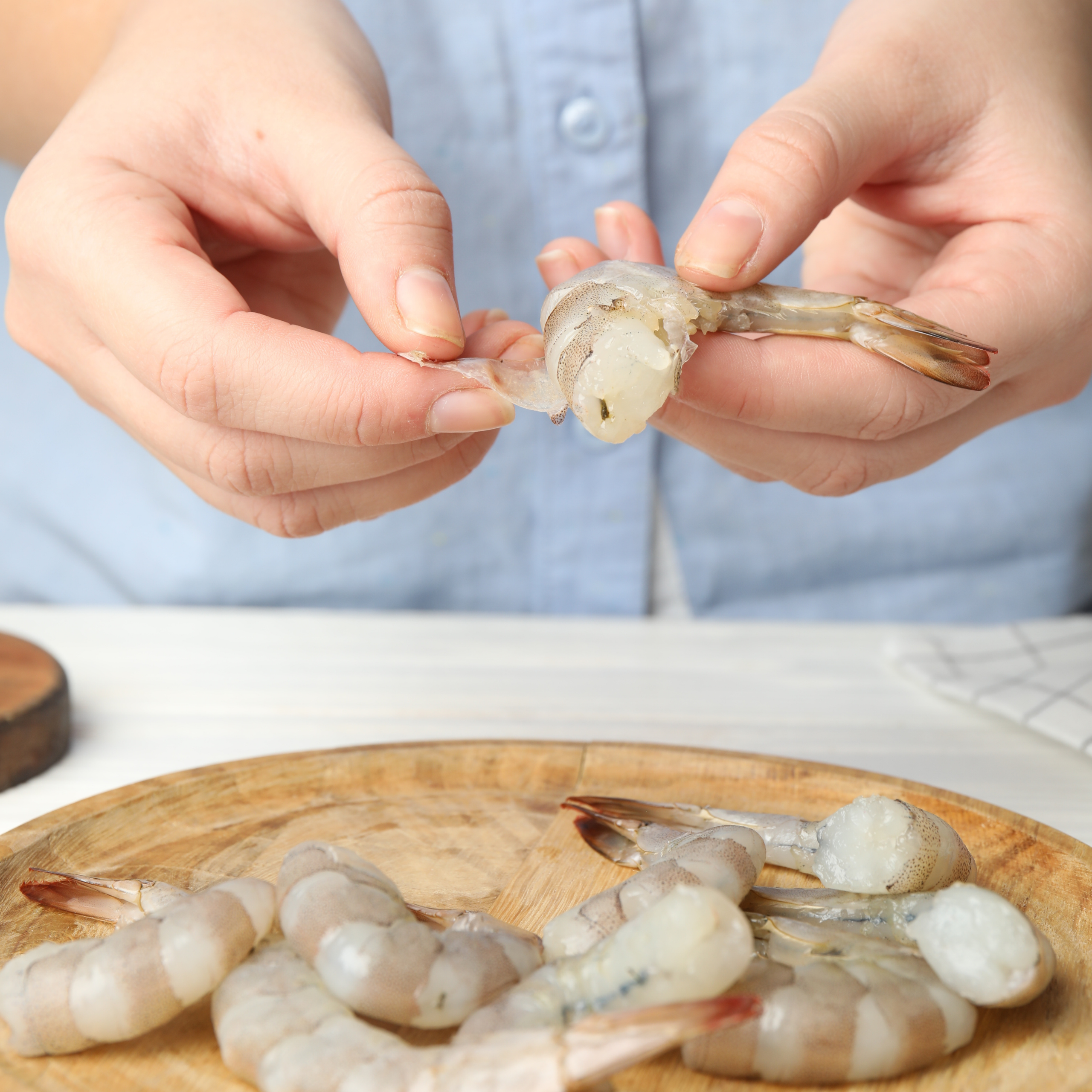
Hands peel a raw shrimp over a wooden board scattered with peeled shrimp, suggesting careful food preparation in a bright, calm kitchen.
Deveining is such a simple yet effective way to elevate your home cooking!

There’s something delightfully primal about eating shrimp: peeling off the skin, twisting the head off, and devouring the whole thing in one bite. 

I feel lucky that my mild shrimp “allergy” isn’t severe enough to require the extreme level of caution others have to live with.

But to be on the other side of the meal, being the one cooking the shrimp instead of just eating it, presents its own set of challenges. The biggest one? Making sure your shrimp is properly cleaned.

​Why You Should Never Skip Deveining

The more I think about it, I think I’ve eaten far more un-deveined shrimp than I’d like to admit.

Some people view deveining as a useless step, failing to see why it’s necessary for a good shrimp dish.

Or you might be someone like me who has watched enough cooking competitions to witness contestants’ dishes be completely untouched by the judges, all because they didn’t properly clean their shrimp. 
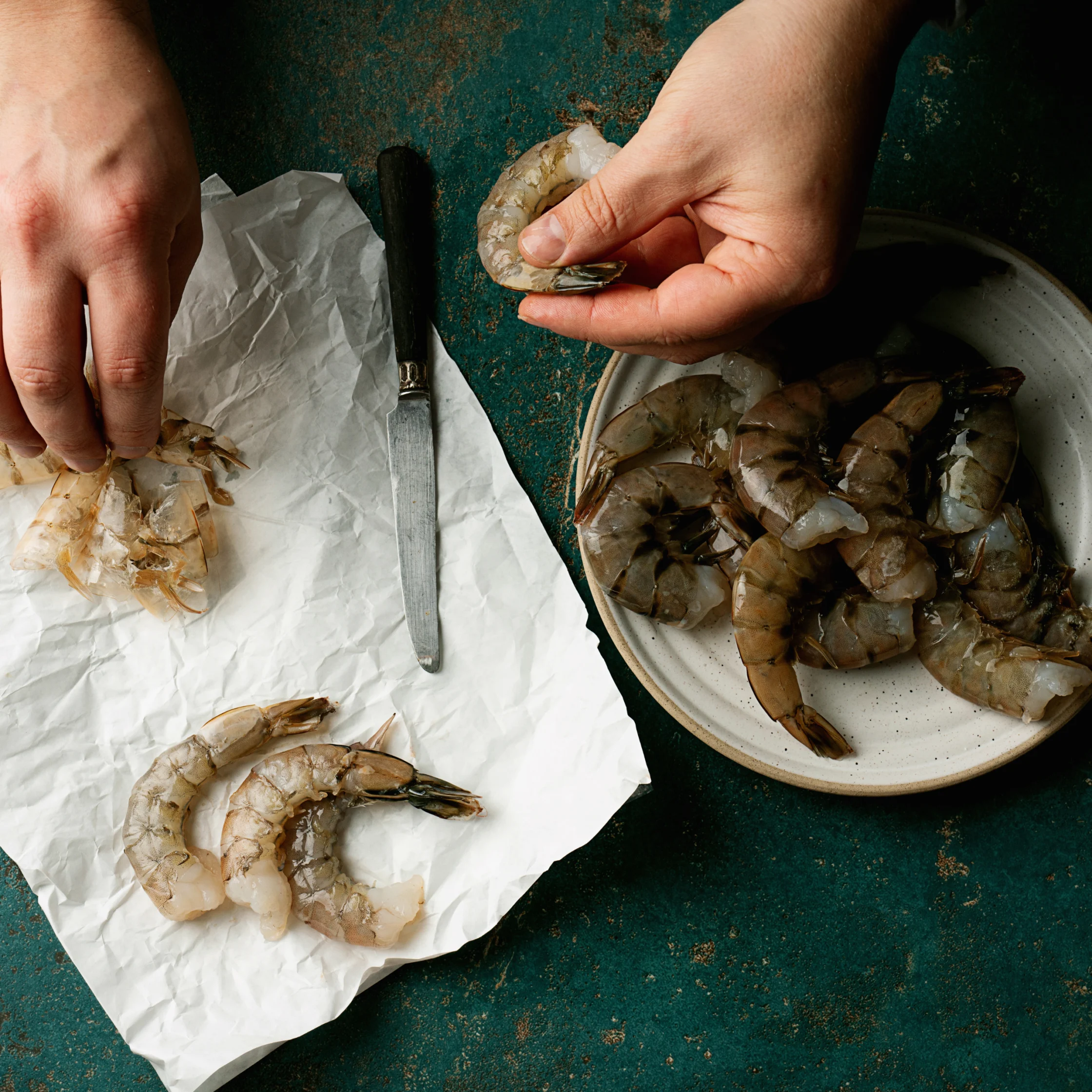
Hands peel raw shrimp over white paper beside a bowl of unpeeled shrimp and a small knife on a dark green surface, showing careful food preparation.
Don’t underestimate what deveining will do to your final dish.

​To clear up any confusion, the “vein” we’re referring to isn’t actually a blood vessel at all. It’s the shrimp’s digestive tract (or as Gordon Ramsay colorfully calls it, the “shit sac”).

​While ingesting it isn’t dangerous, it can turn what should have been a sweet, succulent bite of shrimp into something quite gritty and even a little bitter. 

​Deveining isn’t just a step to keep in mind. It’s a technique worth mastering. If you want to elevate your home cooking and get it right every time, here are five different techniques to try for yourself!

1. Classic knife slice

​The most traditional method used by chefs relies on a sharp knife. Whether you choose a chef’s knife or a paring knife comes down to personal preference—what really matters is that the blade is sharp.

Take your knife and slice gently along the back of your shrimp, making sure you are only cutting about ¼ of the way into the flesh. This has to be one clean, smooth, and consistent cut, so you can do this as slowly as you are comfortable with. Once you’ve cut just enough to expose the vein, you can gently lift it out either with your hands or using the tip of the blade. 

If you are very comfortable using a knife, you can do this while holding the shrimp with your other hand. But if you’re a beginner, you can opt to lay the shrimp on a cutting board for better control and safety. 

​This versatile technique works for almost any recipe. It allows you to clean head-on, headless, peeled, or shell-on shrimp without butterflying or tearing the meat apart. You can make sinigang na hipon and ginataang hipon using whole, beautifully cooked shrimp free of gritty surprises.
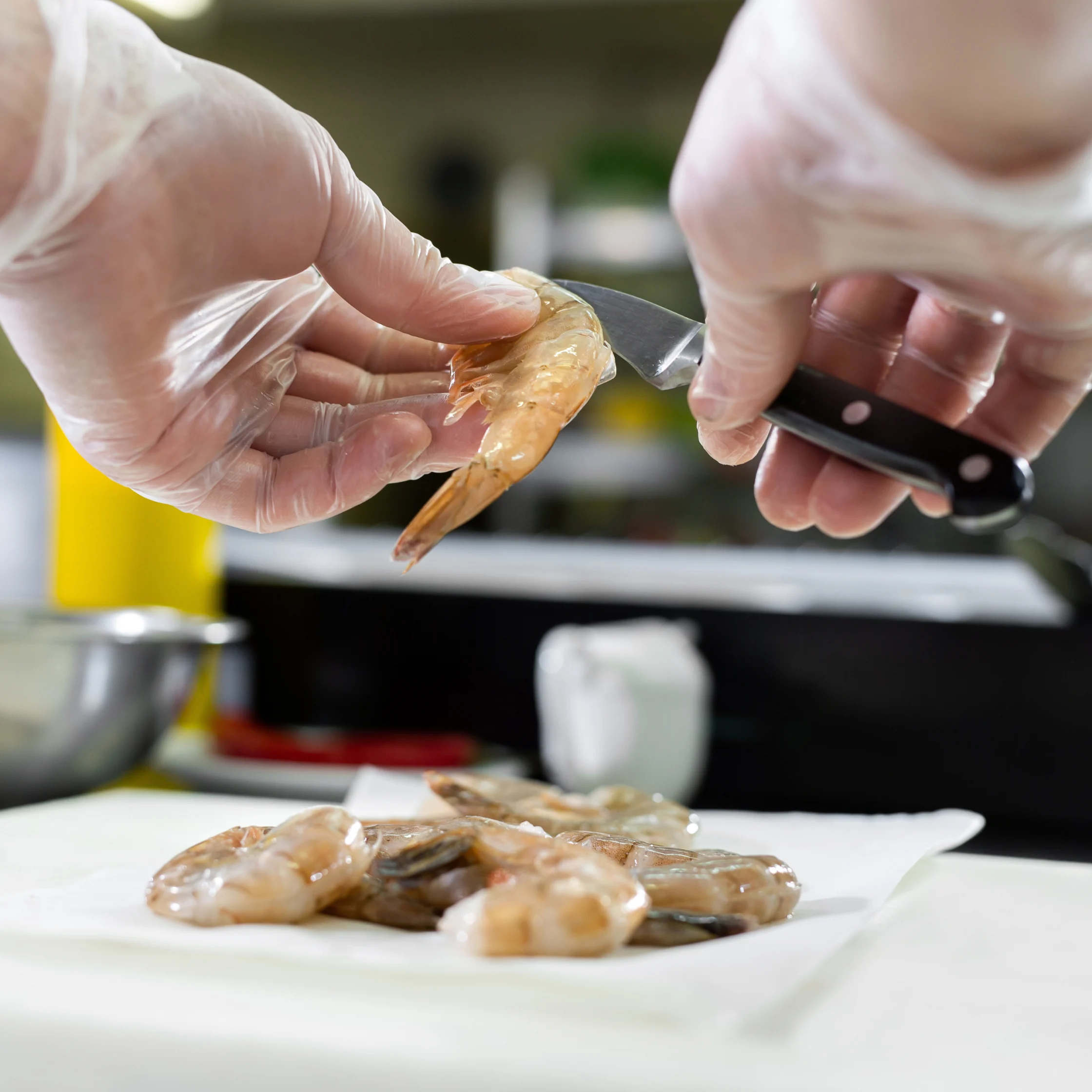
Gloved hands peel a cooked shrimp with a small knife over a plate of seafood in a commercial kitchen, conveying careful food preparation.
Make sure you don’t cut too deep into the shrimp.

2. Using a pair of kitchen scissors

​If presentation isn’t your main priority, kitchen scissors are your best friend. While the end result might not look as tailored, this approach lets you prep and devein large batches of shrimp in record time. Just like the knife method, it works regardless of whether you’re keeping the heads or shells on.

Using your scissors, make a shallow snip starting near the head (or top end) and cut along the outer curvature down to the tail. This cuts through the shell and flesh simultaneously. From there, you can choose to peel the shell off or leave it intact. Because this essentially butterflies the back, you can usually lift the vein out effortlessly in one go.

This method is good for dishes that have shrimp as a supporting ingredient rather than the center of attention like in fried rice, pancit, and pasta dishes. 
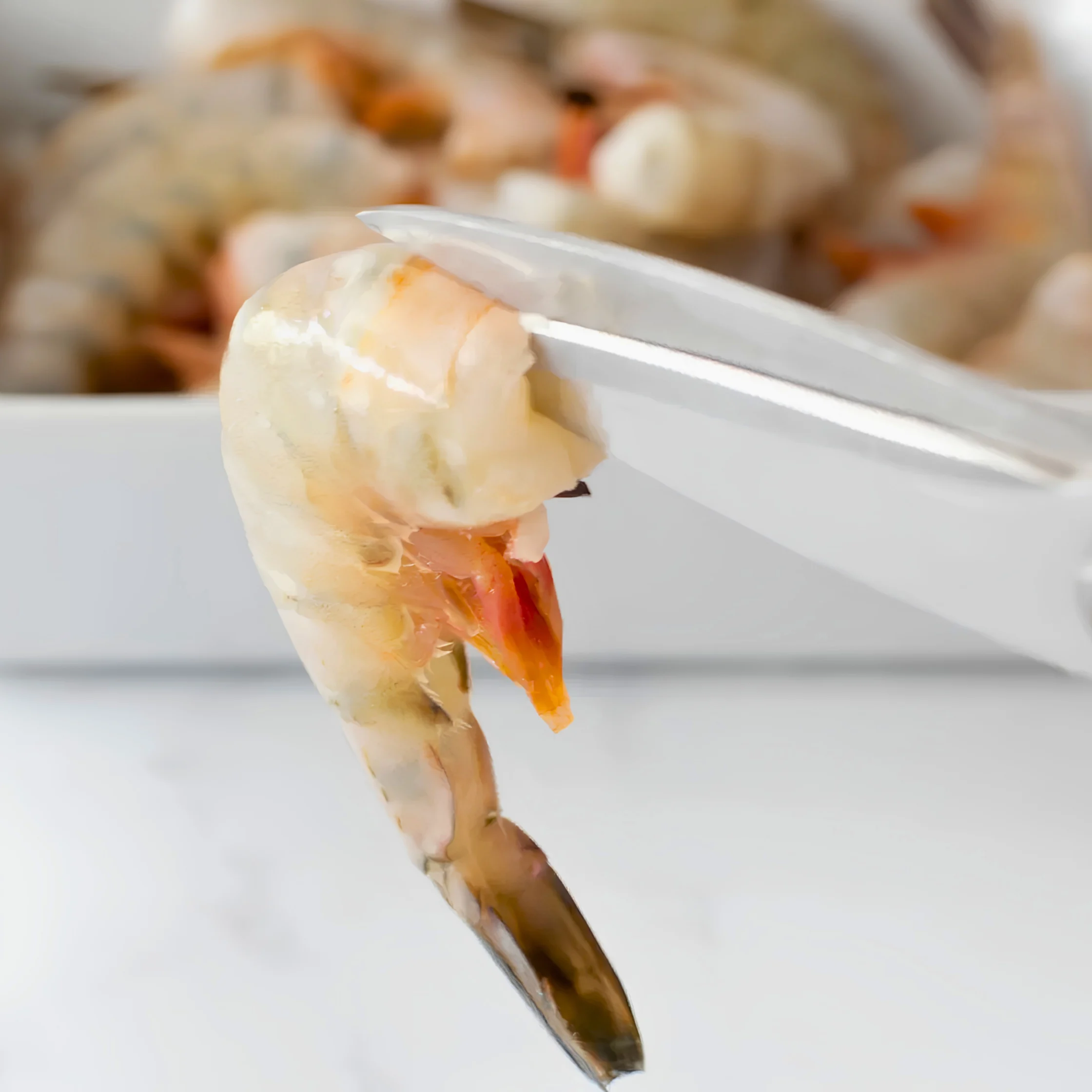
Kitchen scissors trim a raw shrimp over a white surface, with a bowl of uncooked shrimp blurred behind it; a clean, close-up food-prep scene.
Using kitchen shears works best when planning to cook a lot of shrimp in one sitting. [PHOTO COURTESY OF Chef Janet]

3. Using kitchen tweezers

At the opposite end of the spectrum, turn to kitchen tweezers when pristine presentation is the entire point. 

Tweezers work best on headless shrimp, though they work equally well on shell-on or shell-off shrimp. 

Instead of slicing the flesh open, look directly at the top center of the shrimp where the head was attached to locate the exposed tip of the digestive tract. Grip it securely with the tweezers and pull smoothly straight out, just like that!

Admittedly, this technique can feel awkward at first and frustrating if the vein snaps. However, if you’re cooking a dish that calls for perfectly smooth, intact whole shrimp with zero visible cuts or tears, the extra patience pays off.
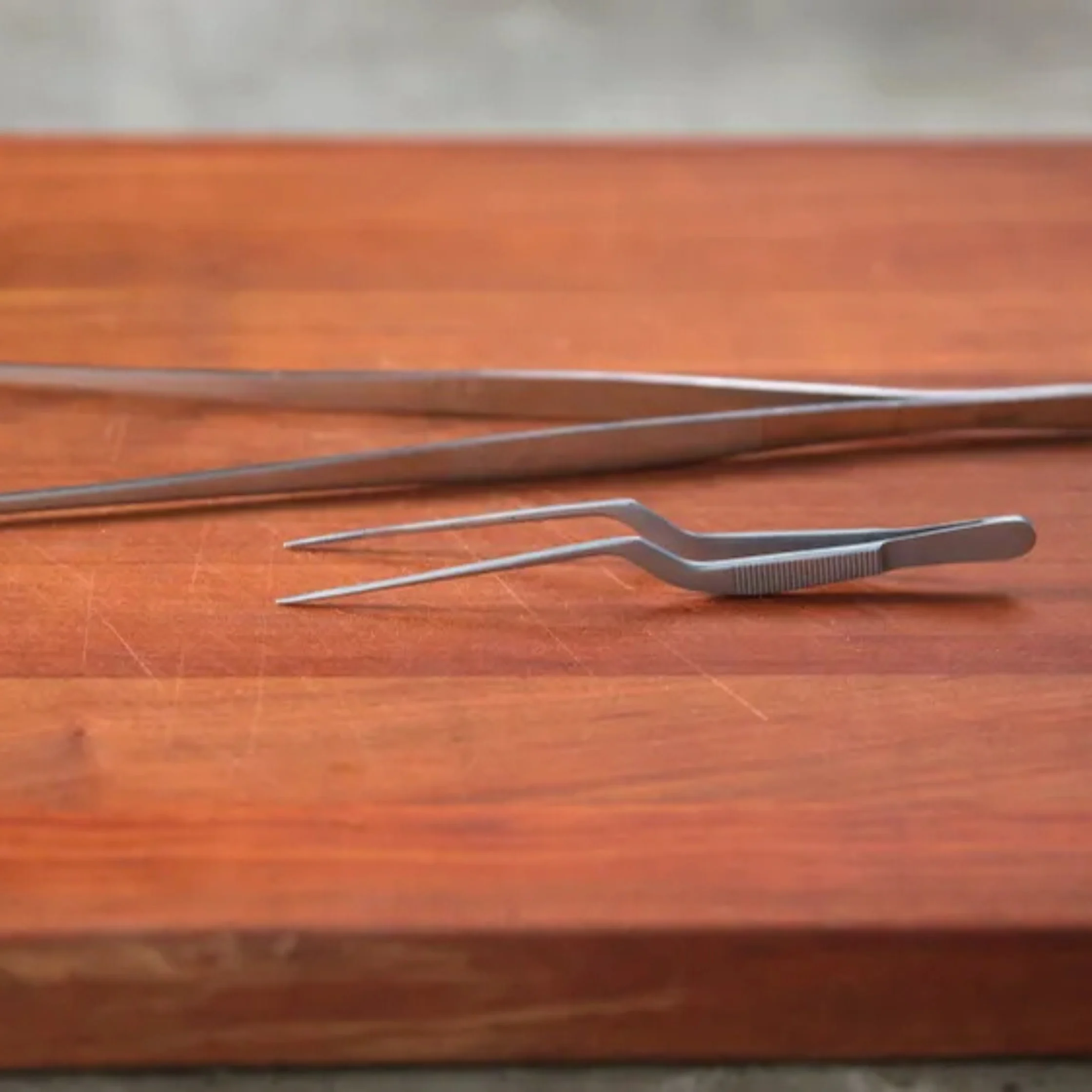
A pair of metal tweezers rests on a reddish wooden surface, one straight and one angled with fine tips, creating a quiet, clinical tone.
Go for kitchen tweezers if you want to keep the structural integrity intact. [PHOTO COURTESY OF Serious Eats]

4. Toothpick shortcut

When I first heard about this method, I was skeptical. After all, isn’t a toothpick just a crude pair of tweezers?

As it turns out, it’s not only shockingly effective, but it’s also incredibly accessible. If you ever find yourself cooking shell-on shrimp away from your usual kitchen setup, a simple box of toothpicks can easily save the day.

Starting from the tail of the shrimp, count up to three shell segments, then bend the shrimp ever so slightly. Take your toothpick and horizontally insert it about a quarter of the way into the shrimp’s back flesh, then gently pull the toothpick upward. It may take a couple of tries, but it will catch beneath the vein and lift it out in one intact piece.

You don’t have to be limited with just using tweezers or toothpicks. I’ve seen videos of people doing the same technique using the prongs of forks, if ever you run out of toothpicks.
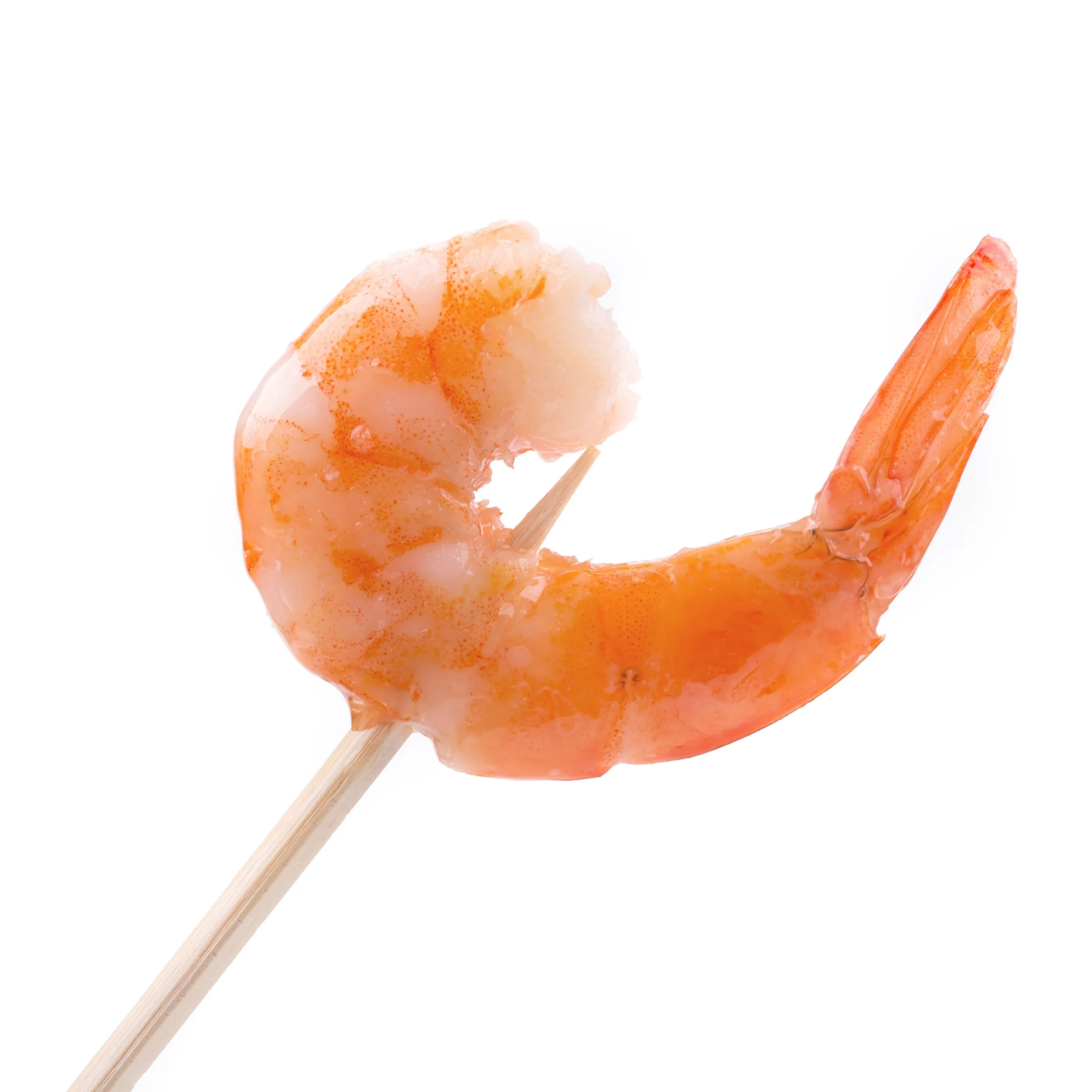
A peeled orange shrimp on a wooden skewer against a plain white background, its curved shape and bright color creating a clean, appetizing look.
Don’t be too hard on yourself if it takes you a few tries to get the “vein” out.

5. Châtrer the shrimp

This last technique came from asking my friend who recently just completed a culinary program. Even beyond that fact, I think this is worth suggesting in the case that neither of the aforementioned tools are readily available in your kitchen.

Don’t let the French term intimidate you. This method doesn’t require any kitchen gadget whatsoever. You just need your two bare or gloved hands.

It’s just two easy steps: twisting the tail and pulling it off. Gently pinch and twist the middle tail fin until it releases from the shrimp. This will sort of help detach the digestive tract from the flesh. From there, pull the middle fin straight out. The digestive tract usually tags along with it in one clean motion. But if it’s your first time trying this, it would be best to double check if there were any pieces of the vein left.

This technique actually also works for cleaning prawns and crawfish.
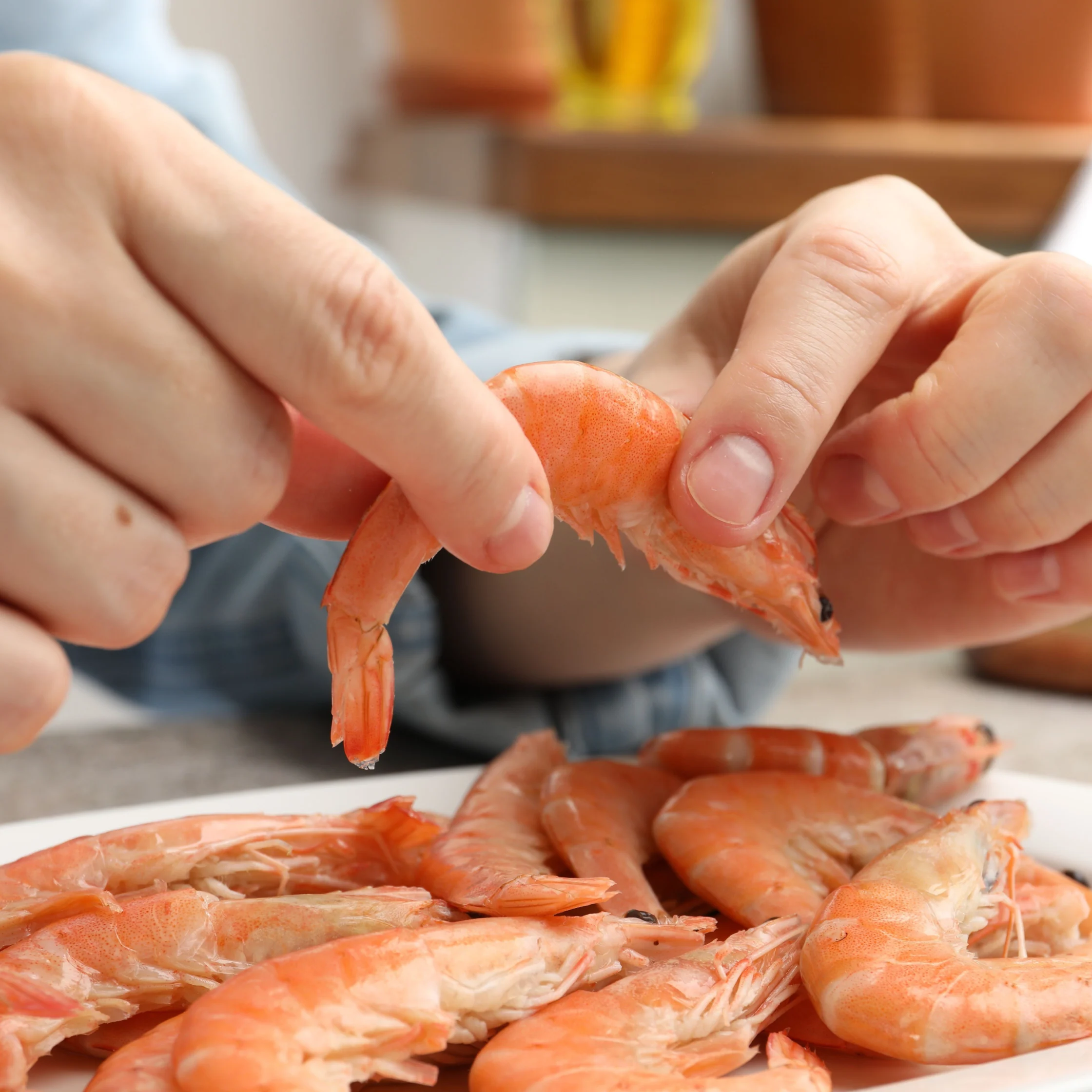
Hands peel a cooked shrimp over a plate piled with pink prawns in a home kitchen, capturing a close-up moment of careful seafood preparation.
It’s as simple as a twist and a pull!

Find Out What Works For You

Whichever method you choose, taking those extra few seconds to devein your shrimp transforms a good home-cooked meal into a restaurant-quality dish. It might feel tedious at first, but with a little practice, it quickly becomes second nature.

So grab your tool of choice and get cooking!

author avatar
Laura Mendoza Writer
Laura admits that she is a slow eater. She prefers to take her time with the food she likes to eat and the stories she wishes to write. Having graduated with a Creative Writing degree, she comes from a background in writing fiction and poetry. Because of this, she has set herself on a creative mission to explore and delve into what other modes and channels exist for stories and narratives to be told, expressed, and shared with others. For Laura, food as a medium is an exciting proposition. Behind every dish, every ingredient, and every cooking technique, there lies a history worth discussing, a human being worth listening to, a lived experience worth gleaning from. As a means to satiate her appetite for learning about and understanding new and known things, she aims to be the kind of food writer who is approachable, reliable, and personable to readers.

Frequently Asked Questions

The dark line running along the back of a shrimp isn’t a blood vessel or vein. It is actually the shrimp’s digestive tract.

author avatar
Laura Mendoza Writer
Laura admits that she is a slow eater. She prefers to take her time with the food she likes to eat and the stories she wishes to write. Having graduated with a Creative Writing degree, she comes from a background in writing fiction and poetry. Because of this, she has set herself on a creative mission to explore and delve into what other modes and channels exist for stories and narratives to be told, expressed, and shared with others. For Laura, food as a medium is an exciting proposition. Behind every dish, every ingredient, and every cooking technique, there lies a history worth discussing, a human being worth listening to, a lived experience worth gleaning from. As a means to satiate her appetite for learning about and understanding new and known things, she aims to be the kind of food writer who is approachable, reliable, and personable to readers.

Yes, ingesting the digestive tract isn’t dangerous or harmful to your health. However, leaving it in can make your shrimp taste gritty, bitter, and unpleasant.

author avatar
Laura Mendoza Writer
Laura admits that she is a slow eater. She prefers to take her time with the food she likes to eat and the stories she wishes to write. Having graduated with a Creative Writing degree, she comes from a background in writing fiction and poetry. Because of this, she has set herself on a creative mission to explore and delve into what other modes and channels exist for stories and narratives to be told, expressed, and shared with others. For Laura, food as a medium is an exciting proposition. Behind every dish, every ingredient, and every cooking technique, there lies a history worth discussing, a human being worth listening to, a lived experience worth gleaning from. As a means to satiate her appetite for learning about and understanding new and known things, she aims to be the kind of food writer who is approachable, reliable, and personable to readers.

You can use kitchen scissors, kitchen tweezers, or just a regular chef’s knife to devein your shrimp.

author avatar
Laura Mendoza Writer
Laura admits that she is a slow eater. She prefers to take her time with the food she likes to eat and the stories she wishes to write. Having graduated with a Creative Writing degree, she comes from a background in writing fiction and poetry. Because of this, she has set herself on a creative mission to explore and delve into what other modes and channels exist for stories and narratives to be told, expressed, and shared with others. For Laura, food as a medium is an exciting proposition. Behind every dish, every ingredient, and every cooking technique, there lies a history worth discussing, a human being worth listening to, a lived experience worth gleaning from. As a means to satiate her appetite for learning about and understanding new and known things, she aims to be the kind of food writer who is approachable, reliable, and personable to readers.

Count up three shell segments from the tail, gently bend the shrimp, and insert a toothpick horizontally about a quarter-inch beneath the vein. Gently pull upward to hook the vein and lift it out.

author avatar
Laura Mendoza Writer
Laura admits that she is a slow eater. She prefers to take her time with the food she likes to eat and the stories she wishes to write. Having graduated with a Creative Writing degree, she comes from a background in writing fiction and poetry. Because of this, she has set herself on a creative mission to explore and delve into what other modes and channels exist for stories and narratives to be told, expressed, and shared with others. For Laura, food as a medium is an exciting proposition. Behind every dish, every ingredient, and every cooking technique, there lies a history worth discussing, a human being worth listening to, a lived experience worth gleaning from. As a means to satiate her appetite for learning about and understanding new and known things, she aims to be the kind of food writer who is approachable, reliable, and personable to readers.

No, the best method depends on what you are making. Somee recipes recommmend leaving the skin and head on while others encourage you to peel and behead your shrimp.

For quick, high-volume prep where appearance doesn’t matter, kitchen shears or toothpicks work best. For more pristine presentation and precision, use a knife or kitchen tweezers.

author avatar
Laura Mendoza Writer
Laura admits that she is a slow eater. She prefers to take her time with the food she likes to eat and the stories she wishes to write. Having graduated with a Creative Writing degree, she comes from a background in writing fiction and poetry. Because of this, she has set herself on a creative mission to explore and delve into what other modes and channels exist for stories and narratives to be told, expressed, and shared with others. For Laura, food as a medium is an exciting proposition. Behind every dish, every ingredient, and every cooking technique, there lies a history worth discussing, a human being worth listening to, a lived experience worth gleaning from. As a means to satiate her appetite for learning about and understanding new and known things, she aims to be the kind of food writer who is approachable, reliable, and personable to readers.
Smiling woman with glasses tilted at an angle, wearing a blue top, against a light background.

Laura Mendoza

Writer

Laura admits that she is a slow eater. She prefers to take her time with the food she likes to eat and the stories she wishes to write. Having graduated with a Creative Writing degree, she comes from a background in writing fiction and poetry. Because of this, she has set herself on a creative mission to explore and delve into what other modes and channels exist for stories and narratives to be told, expressed, and shared with others. For Laura, food as a medium is an exciting proposition. Behind every dish, every ingredient, and every cooking technique, there lies a history worth discussing, a human being worth listening to, a lived experience worth gleaning from. As a means to satiate her appetite for learning about and understanding new and known things, she aims to be the kind of food writer who is approachable, reliable, and personable to readers.

0 0 votes
Total of Ratings
guest
Rating
Ratings for Article
0 Comments
Oldest
Newest Most Voted

To provide a customized ad experience, we need to know if you are of legal age in your region.

By making a selection, you agree to our Terms & Conditions.